Sunday, March 07, 2010

Gamma-ray bursts without the gamma rays?

We discussed supernovae a bit in this recent post on gamma-ray bursts. There is now interesting new information on the connection between supernovae and gamma-ray bursts from two recently-described supernovae with atypical properties.

Let's first review a little. Gamma-ray bursts (GRBs) are identified by detection of relatively brief (usually less than a few minutes) but highly energetic emissions of gamma rays. Although there's a great deal of diversity, most events fall into one of two categories: "short", emitting strongly for less than two seconds, and "long", having strong gamma-ray emissions for more than a few seconds and higher total energy.

Short GRBs are less well understood, but they are commonly thought to result from the merger of two stellar-weight black holes or neutron stars. Short GRBs are not relevant for the present discussion.

Long GRBs are thought, with fairly general consensus, to result from certain types of supernovae (the "core-collapse" kind). One reason for this consensus is that the total energy output of a long GRB appears to be in the same neighborhood as that of a core-collapse supernova: around 1051 ergs (1044 joules, if you prefer). Also, if a GRB occurs sufficiently nearby, we can optically identify it with a bright supernova event, and there have been several instances of this.

Supernovae also come in several different kinds, which differ in their internal mechanisms. The main types are Type I, which have no evidence of hydrogen in their spectra, and Type II, which do have hydrogen lines in the spectrum.

There are further subdivisions of the Type I case: Type Ia supernovae are thought to be associated with progenitors that are white dwarfs. These are the end stage reached by most stars, which have less than about ten times the mass of the Sun (10 M). Such stars lose most of their mass when they pass through an earlier red giant stage. After they have burned (via fusion) all of their hydrogen they shrink down to become white dwarfs with a mass less than about 1 M.

Eventually such a star can no longer produce energy even by fusing heavier elements. The star produces energy only by gravitational contraction. Contraction stops only when degeneracy pressure (due to the Pauli exclusion principle) prevents further collapse. Degeneracy pressure, however, can support a stellar mass only if it's less than 1.38 M – the Chandrasekhar limit. If a star reaches this stage with a mass of more than 1.38 M, it will collapse further into a neutron star or black hole. If this doesn't happen, yet the star later accretes mass from an external source – such as a companion in a multiple star system – the star may wind up with enough additional matter to sustain an explosive fusion reaction – and then you get a Type Ia supernova. There's some controversy now whether this is more likely to happen due to the merger of two white dwarfs or gradual accretion from a companion, but that's irrelevant for the present discussion, because Type Ia supernovae are not associated with GRBs.

The problem with Type Ia supernovae is that there's no conceivable mechanism to create one particular hallmark of a GRB – namely, jets of matter ejected from the explosion in opposite directions at speeds near the speed of light. It takes a particular mechanism called a "central engine" to accelerate matter that dramatically. This mechanism is thought to be a rapidly spinning neutron star or black hole that is surrounded by a gaseous accretion disk. The matter is sucked in by the central object, but because it has such a large amount of angular momentum it is expelled outwards in jets along the axis of rotation, instead of falling into or onto the central object.

A "core collapse" supernova is required in order to produce the right conditions for a central engine of this sort to form. (And even in this case, only a small percentage of events seem to have just the right conditions.)

To have a core collapse supernova, it's necessary for the progenitor star to have a mass more than about 10 M. In this case, which is pretty rare, after a certain point, even though fusion of heavy elements may still be going on, the energy available from fusion becomes insufficient to support the entire mass of the star, and the whole thing then collapses very rapidly to a black hole or neutron star. If there is still some hydrogen remaining in the outer shell of the star immediately before collapse, you get a Type II supernova. Otherwise you get a Type Ib supernova, if there's still some helium remaining, or else a Type Ic (no helium).

If the progenitor star had a mass between about 10 M and 20 M, the end result is a neutron star. Above 20 M the result is a black hole. However, as noted, it's not known what conditions are required in order to have a central engine capable of producing a GRB. From the relative frequency of observed GRBs compared to Type Ib/c or Type II supernovae, the right conditions seem to occur only 1 or 2% of the time.

The new wrinkle that two recently described supernova events exhibit is that it is possible to have relativistic jets of matter from a supernova without detectable gamma ray activity. Just how fast are we talking about in terms of the ejected matter? Well, in an "ordinary" supernova matter is ejected at speeds, at most, only 2 or 3% of the speed of light (which is still plenty fast). Yet in the recent examples, the matter is accelerated to more than 50% of the speed of light.

How is the speed actually measured? Well, the interesting thing is that it's easy to measure at radio frequencies, using radio telescopes. Let's consider the case of the supernova known as SN 2009bb, to be specific, which was first observed on March 21, 2009. This one showed up in a galaxy called NGC 3278, which is about 130 million light-years away.

Astronomers didn't even have to act especially quickly to do the measurement – in fact it's best to do it several weeks after the event. Using radio interferometry it's straightforward to observe the size of the expanding sphere of radio emissions. Divide the radius of the sphere by the time since the initial event and you have (roughly) the rate of expansion.

Actually, it's slightly more complicated than that, because relativistic speeds are involved. It's necessary to apply equations of special relativity. Suppose R is the apparent radius of the sphere, and the time interval is Δt. Then the apparent velocity of expansion is R/Δt. It is even possible for this apparent velocity to exceed c (the speed of light).

However, this apparent velocity is not actually the rate at which the ejected matter is moving. Suppose that rate is denoted by v. Let β=v/c, the ratio of the actual speed to the speed of light. Define the quantity (Lorentz factor) γ=1/√(1-β2). Then what's actually true is that γβc=R/Δt. In the case of SN 2009bb the apparent velocity that was measured was ~0.85c. Solving for β you get β~0.65. That is, ejected matter was moving at about 65% of the speed of light. This matter was just lightweight electrons, but it still takes one honking explosion to move even electrons that fast – perhaps 30 times as fast as what one gets in an "ordinary" supernova.

Here's the research abstract:

A relativistic type Ibc supernova without a detected γ-ray burst
Long duration γ-ray bursts (GRBs) mark the explosive death of some massive stars and are a rare sub-class of type Ibc supernovae. They are distinguished by the production of an energetic and collimated relativistic outflow powered by a central engine (an accreting black hole or neutron star). Observationally, this outflow is manifested in the pulse of γ-rays and a long-lived radio afterglow. Until now, central-engine-driven supernovae have been discovered exclusively through their γ-ray emission, yet it is expected that a larger population goes undetected because of limited satellite sensitivity or beaming of the collimated emission away from our line of sight. In this framework, the recovery of undetected GRBs may be possible through radio searches for type Ibc supernovae with relativistic outflows. Here we report the discovery of luminous radio emission from the seemingly ordinary type Ibc SN 2009bb, which requires a substantial relativistic outflow powered by a central engine. A comparison with our radio survey of type Ibc supernovae reveals that the fraction harbouring central engines is low, about one per cent, measured independently from, but consistent with, the inferred rate of nearby GRBs.


There's a practical application of this discovery. It means that astronomers can use radio telescopes to identify supernova events in which a central engine is involved, even if no gamma rays are detectable. Eventually this will help figure out more precisely what conditions are necessary in order to create the central engine.

There are several possible reasons why gamma rays may not be detectable in such events. It could be that sufficiently powerful gamma rays simply are not produced in some cases. Or else they are produced, but quickly absorbed in the neighborhood of the event so that we never see them. Finally, since the gamma rays are presumably directed in a narrow beam, like the ejected matter, the beam simply is not along our line of sight.

A very similar result has also just been reported for the supernova SN 2007gr. This one is in a somewhat closer galaxy, NGC 1058, about 34 million light-years away. In this case, matter was ejected with β~0.52, corresponding to an apparent rate of 60% of the speed of light. Again, no associate gamma ray emission was detected.

The research report:

A mildly relativistic radio jet from the otherwise normal type Ic supernova 2007gr
The class of type Ic supernovae have drawn increasing attention since 1998 owing to their sparse association (only four so far) with long duration γ-ray bursts (GRBs). Although both phenomena originate from the core collapse of a massive star, supernovae emit mostly at optical wavelengths, whereas GRBs emit mostly in soft γ-rays or hard X-rays. Though the GRB central engine generates ultra-relativistic jets, which beam the early emission into a narrow cone, no relativistic outflows have hitherto been found in type Ib/c supernovae explosions, despite theoretical expectations and searches. Here we report radio (interferometric) observations that reveal a mildly relativistic expansion in a nearby type Ic supernova, SN 2007gr. Using two observational epochs 60 days apart, we detect expansion of the source and establish a conservative lower limit for the average apparent expansion velocity of 0.6c.


ResearchBlogging.org
Soderberg, A., Chakraborti, S., Pignata, G., Chevalier, R., Chandra, P., Ray, A., Wieringa, M., Copete, A., Chaplin, V., Connaughton, V., Barthelmy, S., Bietenholz, M., Chugai, N., Stritzinger, M., Hamuy, M., Fransson, C., Fox, O., Levesque, E., Grindlay, J., Challis, P., Foley, R., Kirshner, R., Milne, P., & Torres, M. (2010). A relativistic type Ibc supernova without a detected γ-ray burst Nature, 463 (7280), 513-515 DOI: 10.1038/nature08714


ResearchBlogging.org
Paragi, Z., Taylor, G., Kouveliotou, C., Granot, J., Ramirez-Ruiz, E., Bietenholz, M., van der Horst, A., Pidopryhora, Y., van Langevelde, H., Garrett, M., Szomoru, A., Argo, M., Bourke, S., & Paczyński, B. (2010). A mildly relativistic radio jet from the otherwise normal type Ic supernova 2007gr Nature, 463 (7280), 516-518 DOI: 10.1038/nature08713


Further reading:

Astronomers Find Rare Beast by New Means (1/27/10)

Oddball Cosmic Explosion Holds Clues to Universe's Biggest Bangs (1/27/09)

Newborn Black Holes May Add Power to Many Exploding Stars (1/27/10)

Astronomers in the Netherlands catch supernova, observe relativistic expansion (1/27/10)

Star Shoots out Material at Close to the Speed of Light (1/28/10)

Some baby black holes give boost, but no burst (1/29/10)

Supernovae linked to gamma ray bursts (1/28/10)

The Birth Place of the Type Ic Supernova 2007gr

Doctor Who and the Silver Spiral (1/27/10)

Labels: , ,

Saturday, January 30, 2010

Magnetic fields in gamma-ray burst jets

Gamma-ray bursts (GRBs) are the most dramatic short-lived violent events observed in the universe. They are often described as releasing a quantity of energy, in less than a minute, that is at least as much as a star like the Sun releases in its entire 10 billion year lifetime. Since the first detection of a gamma-ray burst in 1967, the central question has been to determine the nature of the process or processes that can release so much energy so quickly.

We've discussed gamma-ray burst several times before, such as here, here, and here.

The defining characteristic property of a GRB is a rapid, highly energetic burst of gamma rays, lasting only a few seconds. Most of the GRB energy is released in that event. But beyond that, GRBs exhibit a bewildering diversity of characteristics – reflecting a diversity in the conditions that can produce a GRB.

The most noticeable difference observed in GRBs is that some events are over very quickly – within 1 or 2 seconds – while others include an "afterglow" of radiation less energetic than gamma rays, lasting as long as minutes in some cases. In a few instances there are events that have some properties of both "short" and "long" types of GRB.

Gamma rays cannot penetrate the Earth's atmosphere, so the initial phase of any GRB is detectable only from a satellite-based instrument. This is rather limiting in terms of the types of observations that can be made. For example, satellites lacked instruments that could record a spectrum of a GRB event in lower-energy electromagnetic radiation. Without a spectrum, astronomers cannot measure redshift, and hence the distance of the event.

The development and deployment within the last 10 years of systems that could use satellite detection of GRBs to activate automated ground-based telescopes have dramatically improved this situation. It's now possible to collect much more detailed data, so that astronomers have been able to learn a lot more about GRBs – in many cases.

Even so, many short GRB events are over in just a few seconds, and therefore much less is yet known about short GRBs. The best current guess is that such events are caused by the merger of a pair of binary neutron stars.

The research to be described here, therefore, concerns long GRBs, where it is relatively easy to study the characteristics of the lower-energy electromagnetic radiation, which makes up the afterglow for several minutes or even tens of minutes after the initial burst.

A general consensus has emerged that gamma-ray burst progenitors are certain types of supernovae. Not just any type, either, because the progenitor must be capable of releasing the amount of energy actually observed in a GRB. This rules out Type Ia supernovae, which result from a thermonuclear explosion of matter that has accreted onto the surface of a white dwarf star.

Type Ia supernovae are important in cosmology, because they all have roughly the same intrinsic brightness. This makes it possible to determine the approximate distance of a Type Ia supernova event, just from the observed brightness. By comparing this distance with the redshift of the supernova it is possible to determine how rapidly the universe has expanded in the past. This, in turn, is what made it possible to conclude, in 1997, that the expansion of the universe is accelerating.

However, the energy released by a Type Ia supernova is far too small to account for a GRB. Instead, a different supernova mechanism, known as "core collapse" is needed. Classification of supernovae is a little confusing, since it was originally done on the basis of spectral characteristics. Type II supernovae have a particular line in their spectrum due to hydrogen, while Type I supernovae do not.

Type II supernovae result from the collapse of very massive stars at the end of their lives, when they can no longer support their own weight by the pressure of fusion occuring in their constituent matter. But it turns out that some supernovae lacking the hydrogen spectral line are too energetic to result from the same mechanism as that of Type Ia supernovae. These types are known as Type Ib and Type Ic, and they also result from core collapses of massive stars (that have already burned off all their hydrogen).

So there are significant differences even among core collapse supernovae, resulting from such factors as the total mass of the progenitor star and the original composition of the star, among other things. Such differences can account for some of the differences observed if such supernovae are responsible for GRBs.

But by no means all core collapse supernovae produce a GRB. Theoretical considerations dictate that several other factors must also be present. For one thing, the supernova must result in the formation of a black hole that is massive enough to support a large accretion disk of matter orbiting around it. A neutron star, which is the alternative remnant of a supernova, just isn't massive enough. To get a sufficiently massive black hole, the progenitor star must be at least 40 Solar masses.

High mass alone, however, is not enough. The progenitor star must also be rotating rapidly enough that the angular momentum of the system is large enough to cause most of the matter and energy from the supernova explosion to be focused into a jet of angular width at most about 20 degrees. This concentrates most of the energy of the explosion into a narrow beam, so that the energy emitted in our direction matches what we actually observe. If the beam were not so narrow, the energy would not appear to be the magnitude that we observe.

There are additional factors that affect the varying characteristics of GRBs that we observe. In particular, the distribution of matter in the interstellar medium surrounding the supernova is important. It is the collision between the jets and this matter that determines the intensity and duration of the afterglow we observe for some time after the original burst.

And there's more. The jets of matter and energy from a GRB event may well be powered by the energy of the original explosion. But that's not the only possibility. Suppose there are strong magnetic fields surrounding the progenitor star. Then there will also be a considerable amount of energy in the magnetic flux, and this can also supply power to the jets.

Strong magnetic fields would have another consequence as well. The jets consist partly of electrons moving at relativistic speeds (very close to the speed of light). These electrons will follow a spiral path around lines of magnetic flux. This creates a type of electromagnetic radiation known as synchrotron radiation. If present, this radiation would make up part of the afterglow we can observe.

How would we know if synchrotron radiation, and hence magnetic fields, are present? That's simple – the radiation would be partly polarized, provided that the magnetic fields are orderly and not all tangled up.

And this is precisely what recent research has observed in the case of one particular GRB event (GRB 090102), which was detected January 2, 2009. Specifically, a polarization of 10±1% was observed at optical wavelengths. This degree of polarization is quite rare in astrophysical events, and it strongly suggests the presence of large-scale magnetic fields associated with GRB 090102. These fields should contribute substantially to the observable energy of the GRB.

Abstract:

Ten per cent polarized optical emission from GRB 090102
The nature of the jets and the role of magnetic fields in gamma-ray bursts (GRBs) remains unclear. In a baryon-dominated jet only weak, tangled fields generated in situ through shocks would be present. In an alternative model, jets are threaded with large-scale magnetic fields that originate at the central engine and that accelerate and collimate the material. To distinguish between the models the degree of polarization in early-time emission must be measured; however, previous claims of gamma-ray polarization have been controversial. Here we report that the early optical emission from GRB 090102 was polarized at 10 ± 1 per cent, indicating the presence of large-scale fields originating in the expanding fireball. If the degree of polarization and its position angle were variable on timescales shorter than our 60-second exposure, then the peak polarization may have been larger than ten per cent.


ResearchBlogging.org
Steele, I., Mundell, C., Smith, R., Kobayashi, S., & Guidorzi, C. (2009). Ten per cent polarized optical emission from GRB 090102 Nature, 462 (7274), 767-769 DOI: 10.1038/nature08590


Further reading:

Magnetic Power Revealed in Gamma-Ray Burst Jet (12/9/09)

Huge Cosmic Explosions Fueled by Magnetism (12/9/09)

Gamma-ray bursts: Magnetism in a cosmic blast (12/10/09)

In the News this month: the role of magnetic fields in GRBs (1/3/10)

Labels: , , ,

Monday, October 13, 2008

Powerful Nearby Supernova Caught By Web

Powerful Nearby Supernova Caught By Web
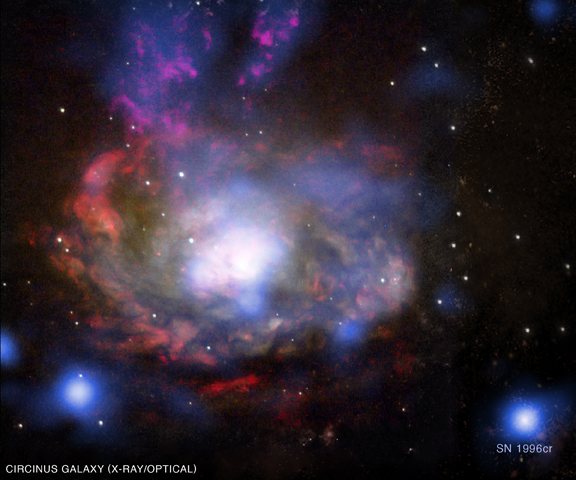
This composite image shows the central regions of the nearby Circinus galaxy, located about 12 million light years away. Data from NASA's Chandra X-ray Observatory is shown in blue and data from the Hubble Space telescope is shown in yellow ("I-band"), red (hydrogen emission), cyan ("V-band") and light blue (oxygen emission). The bright, blue source near the lower right hand corner of the image is the supernova SN 1996cr, that has finally been identified over a decade after it exploded.

Optical images from the archives of the Anglo-Australian Telescope in Australia show that SN 1996cr exploded between February 28, 1995 and March 15, 1996. Among the five nearest supernovas of the last 25 years, SN 1996cr is the only one that was not seen shortly after the explosion. It may not have been noticed by astronomers at the time because it was only visible in the southern hemisphere, which is not as widely monitored as the northern.


Circinus galaxy with SN 1996cr – click for 576×480 image

Labels: ,

Sunday, June 01, 2008

GLAST and gamma-ray astronomy

According to the present schedule, the GLAST gamma-ray telescope mission will be launched next week, on June 5, around noon EDT. If you're reading this before then, you can expect to find quite a bit of news coverage around that date. It's actually kind of a big deal, and I'll summarize some of the reasons for that here.

To begin with, you can find background information on the mission from NASA here and here.

In addition, there have been some good summaries already in science-oriented publications:

You can find good explanations of exactly what GLAST is in most of the above references.

What I'll summarize here are just some of the main objects and phenomena that GLAST is expected to help observe and study.

Gamma-ray bursts
Gamma-ray bursts (GRBs) have been discussed here several times, such as here and here. It is generally agreed that there are several different events that can cause a GRB, and a fair amount is known about the phenomenon already. For instance, the subtype known as a "long" GRB is thought to result from supernova explosions in which a high-energy jet of particles and radiation is emitted in a narrow beam that happens to point in our direction. But as yet we haven't measured the complete spectrum of energy from a GRB of any type. This spectrum can range from a few KeV to hundreds of GeV, and knowing it in detail would help determine the nature of the associated event much more accurately.

Dark matter
The visible universe that consists of luminous objects like stars and galaxies is composed of baryonic matter (mainly protons and helium nuclei). There may be at least as much baryonic matter in the form of diffuse gas that we cannot see. (Recent observations here and here.)

Yet it is essentially certain that the universe actually contains about four times as much matter that we can't detect at all (except by its gravitational effects) as all that baryonic matter put together. This is the dark matter. There are many theories about what this dark matter consists of, but in one of the main classes of theories, the matter consists of "weakly-interacting massive particles" (WIMPs). In most such theories, WIMPs can annihilate each other in pairs, giving off copious quantities of gamma-rays (among other things).

If some such theory accounts for a portion of the dark matter, GLAST will make it possible to estimate properties of WIMPs (e. g. their mass) by observing gamma-rays from locations where dark matter is expected to be concentrated, such as in the center of the Milky Way. This kind of information will complement and help corroborate observations made at the Large Hadron Collider, in which some kinds of WIMPs (if they exist at all) are expected to be created.

Solar gamma-rays
Although our Sun is a relatively weak source of gamma-rays compared to almost everything else mentioned here (even weaker than the Moon, where gamma-rays are produced when cosmic rays strike the surface), several solar events, such as flares and coronal mass ejections do produce gamma-rays. So GLAST will help us better understand solar events of this kind.

Supernova remnants
A large class of gamma-ray bursts are associated with the initial blast of a supernova event, and the gamma-rays from such bursts subside in a matter of minutes. But other gamma-rays may originate by other mechanisms from the supernova remnant long after the original event. Gamma-rays are thought to be produced in such remnants due to particles being accelerated to high energies in the blast and subsequently generating shock waves in the interstellar medium. The shock waves themselves are reasonably well understood, but how the particles are actually accelerated by the supernova blast needs much more elucidation, which GLAST can provide.

Pulsars
Another part of the remnant left over after a supernova is either a stellar-mass black hole, or else a rapidly spinning neutron star. Such a neutron star will produce jets of electromagnetic energy, usually at radio frequencies, and when the Earth is lined up with the jet the object is called a pulsar. These also emit gamma-rays. Since neutron stars are extremely small and dense, they have intense magnetic fields near their surface, and the fields reveal a lot about the nature of matter in the neutron star. The strong fields also convert gamma-rays into electron-positron pairs, so the overall gamma-ray spectrum can give us information about the object's magnetic fields, and about surface features that cause gamma-ray emission.

Supermassive black holes, active galactic nuclei, quasars, blazars
Supermassive black holes are thought to exist at the centers of most or all galaxies. We can estimate that they have masses ranging from 105 to 1010 solar masses, yet there is a great deal more we would like to know about them, such as the process by which they form. (See here.) Most supermassive black holes are thought to be circled by an accretion disk of matter which has been attracted by the object's extreme gravity.

Depending on the amount of matter in the disk, large amounts of energy may be released as the matter falls into the black hole. Our own Milky Way has a smallish object of this sort, with a correspondingly small accretion disk. But if there is much more mass in the disk, one has a bright object called an active galactic nucleus (AGN). AGNs were more plentiful in the early days of the universe, before most of the available nearby matter had been consumed by the black hole, and especially active objects of this kind, usually at great distances, are called quasars.

Like supernovae (from which stellar-mass black holes or neutron stars are formed), supermassive black holes may emit powerful relativistic jets of particles and energy. If such a jet is pointed in our direction, we see an especially bright source, called a blazar. Most of the emitted electromagnetic energy from all these objects is in the gamma-ray part of the spectrum.

So one of the main objectives of GLAST is to measure how this spectrum varies over time, in order to get a better understanding of what is actually going on. For instance, there could be additional confirmation of a model of the relativistic jets as described in this recent research, and perhaps evidence as to whether the particles in the jets are protons or electrons.

Cosmic ray origins
As discussed in detail here, we are finally beginning to clear away some of the mystery surrounding the most energetic ultra-high-energy cosmic rays (UHECRs). But there's a lot more we'd like to know, such as whether these rays are mostly made up of relativistic protons, and what sort of process creates them in the first place. Gamma-rays are produced when UHECRs interact with interstellar gas and dust, so GLAST may be able to give us more information about UHECRs.

Primordial black holes
It is generally suspected that many small black holes (with masses covering a wide range, but much less than the mass of a star) could have been produced in the big bang. These are called primordial black holes. Their existence hasn't yet been confirmed. But Stephen Hawking made a strong case that any black hole will slowly emit weak electromagnetic radiation, due to quantum effects and called Hawking radiation. This radiation should be too weak to be directly observable. However, small primordial black holes should eventually evaporate completely by this process, and at the end disintegrate in a burst of gamma-rays. This is all rather conjectural, but if it happens, it may contribute to a continuous gamma-ray background that can be detected.

Cosmic gamma-ray background
In addition to discrete gamma-ray sources such as GRBs and supernova remnants, there is a diffuse background of gamma-ray photons, much like the cosmic microwave background (CMB), only vastly more energetic. Some of this background may be due to UHECRs, very distant and very powerful (TeV range) gamma-ray sources, or primordial black holes. But who knows what other kinds of sources might be out there? There will probably be some surprises, as well as a lot of useful information to be deduced, just as happened with the CMB.

Possible breakdowns of special relativity
Heading even further into speculative territory, various theorists of quantum gravity have proposed that even special relativity (as well as general relativity too) may break down under various conditions. For example, the speed of light might not be an exact constant, but might instead vary by a slight amount according to the energy carried by individual photons.

Thus not all gamma-ray photons from a GRB would need arrive at precisely the same time, and so any pattern in this radiation would be shifted very slightly depending on what part of the gamma-ray spectrum is observed. Even if the shift is as little as 1/1000 of a second (for photons that may have been travelling for billions of years), GLAST should be sensitive enough to detect the shift. That would certainly be quite a surprise if found.


Further reading:

GLAST Science Writer's Guide – An extremely informative 47-page document (PDF), with detailed descriptions of the relevant science, a glossary, and additional links

Simona Murgia: Dark Matter searches with GLAST – Blog posting that discusses the relevance of GLAST for dark matter searches

Tags: , , , , , , ,

Labels: , , , , , , , ,

Sunday, April 13, 2008

Exploding star in NGC 2397

Exploding star in NGC 2397 (3/31/08)
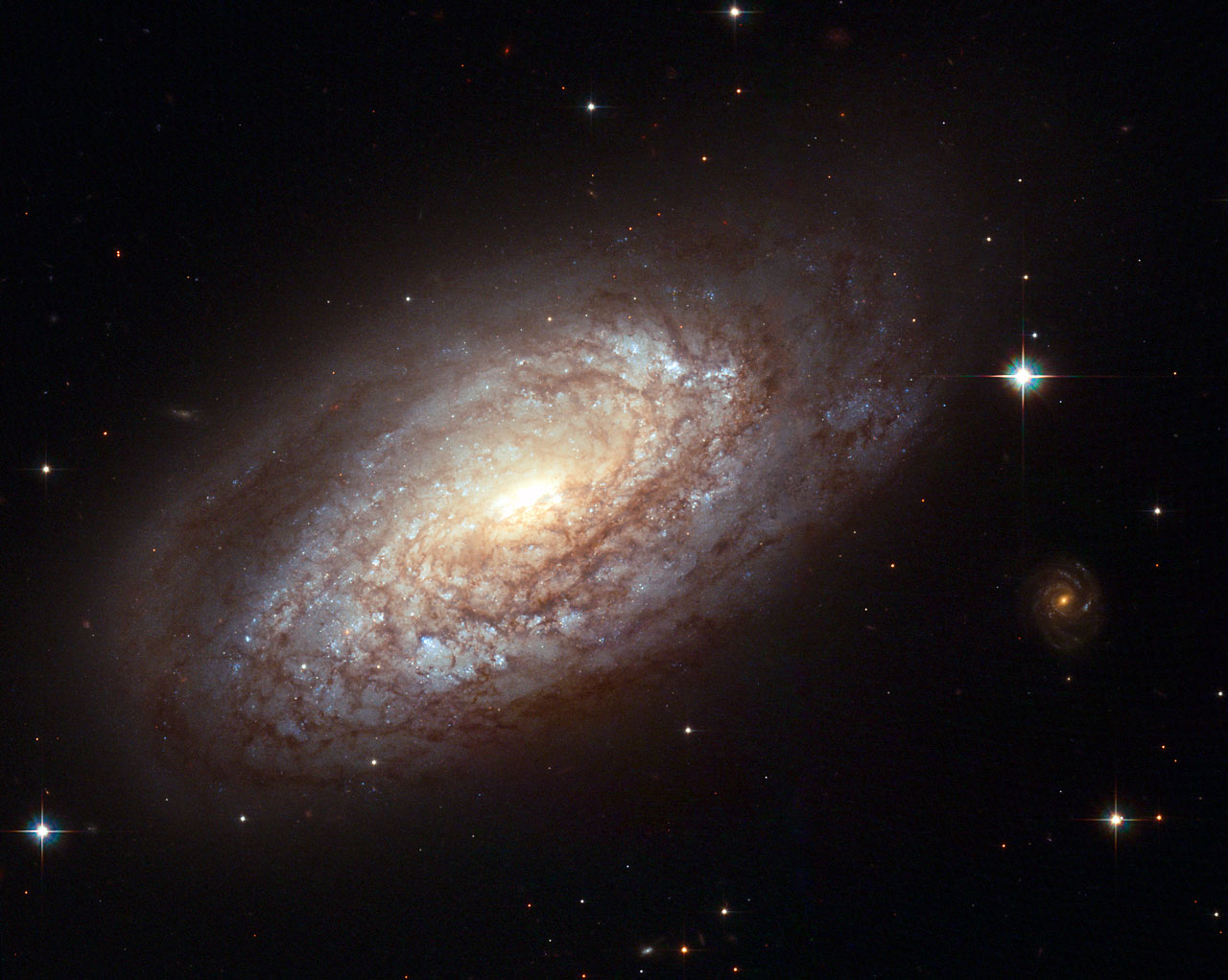
The latest image from the NASA/ESA Hubble Space Telescope reveals a sharp view of the spiral galaxy NGC 2397. This image also shows a rare Hubble view of the late stages of a supernova - SN 2006bc, discovered in March 2006.

NGC 2397, pictured in this image from Hubble, is a classic spiral galaxy with long prominent dust lanes along the edges of its arms, seen as dark patches and streaks silhouetted against the starlight. Hubble’s exquisite resolution allows the study of individual stars in nearby galaxies.

Located nearly 60 million light-years away from Earth, the galaxy NGC 2397 is typical of most spirals, with mostly older, yellow and red stars in its central portion, while star formation continues in the outer, bluer spiral arms. The brightest of these young, blue stars can be seen individually in this high resolution view from the Hubble’s Advanced Camera for Surveys (ACS).


NGC 2397 – click for 1280×1022 image

Labels: ,

Thursday, January 17, 2008

Supernova Remnants Dance in the LMC

Supernova Remnants Dance in the LMC

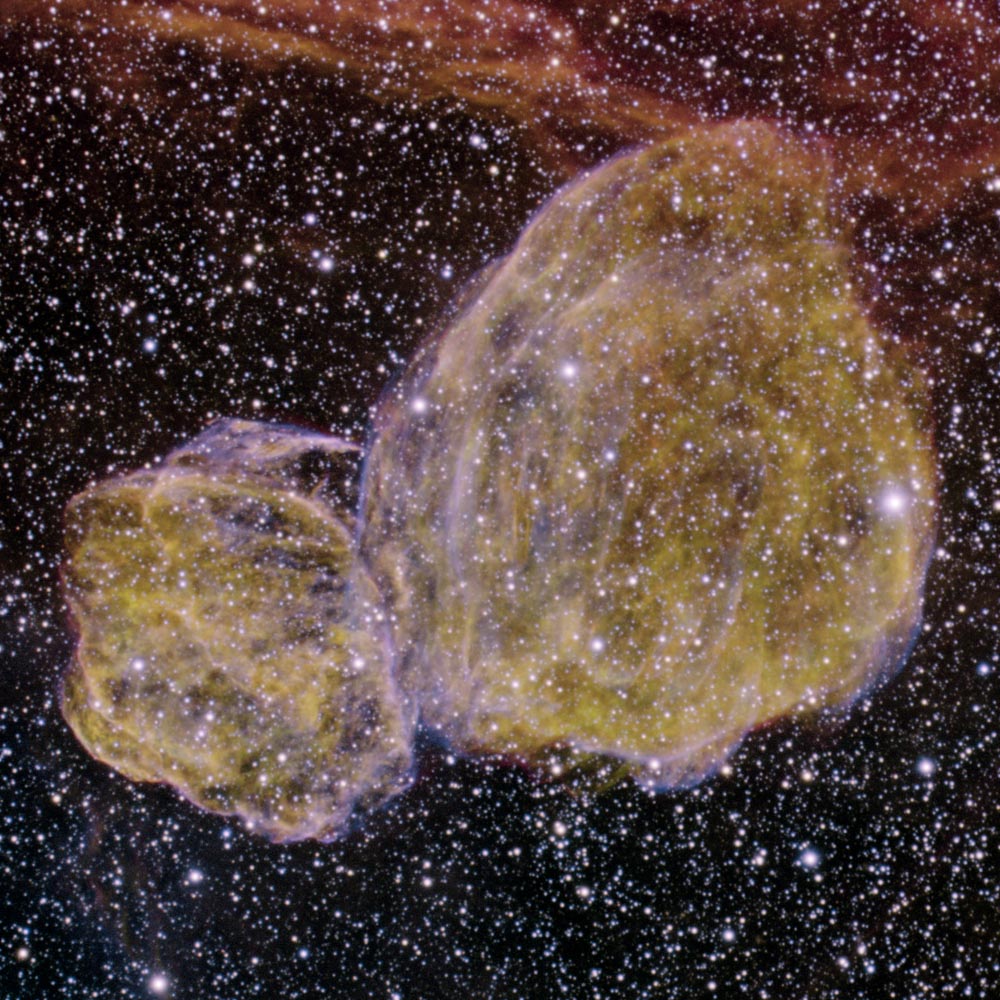
The Gemini South Multi-Object Spectograph (GMOS) recently captured a dramatic image of a vast cloud complex named DEM L316 located in the Large Magellanic Cloud. The peanut-shaped nebula appears to be a single object, but the latest research indicates that it is really comprised of two distinct gas and dust clouds formed by different types of supernova explosions.

The new image reveals the intricate tendrils of gas and dust located in the remnants of the stellar explosions that created the still-expanding cloud complex. The object was first recognized in the early 1970s as a supernova remnant, a type of object that is enriched with elements created in stellar explosions. The nebula was likely created a few tens of thousands of years ago by more than one type of supernova exploding in this region of the Large Magellanic Cloud.


DEM L316 – click for 1000×1000 image


Additional information: here

Labels:

Monday, December 10, 2007

Ultra-high energy cosmic rays.

I'm just trying to catch up on interesting science news of the past few weeks, and what happens? I pick a topic that seems to have had significant new developments and is also straightforward enough for a relatively brief post. But instead of something I can do justice to with just a handful of links to good reports (so I don't need to do that much work), I find myself in a brier patch. Frustrating.

The general topics is cosmic rays. The phenomenon of radioactivity was discovered in 1896 by Henri Becquerel. At first the only known source of radioactivity was certain naturally occurring radioactive elements in the Earth itself. But in 1912 Victor Hess deduced that there must be another source of radioactivity outside the Earth's atmosphere. These came to be known as cosmic rays (as opposed to other kinds of "rays", such as X-rays, alpha rays, beta rays, and gamma rays, which have known terrestrial sources). Hess received a Nobel Prize in physics in 1936 for his discovery, indicating that by then scientists generally agreed the phenomenon was genuine, and interesting.

Given that, the next questions had to be: what do cosmic rays consist of, and how are they produced? Even today we are still in the process of answering those two questions, though we think the answers are pretty well known for all but the most energetic cosmic rays.

I'll discuss cases involving different energies in a moment, but first there are some basic distinctions. Now that we have spacecraft, we can in principle observe cosmic rays directly, though this hasn't actually been done systematically. (It turns out that the highest energy cosmic rays, which are still the least well understood, are too rare to be observable with non-terrestrial instruments of sufficient size.) At the Earth's surface we can't observe cosmic rays directly. Assuming cosmic rays are ordinary particles like electrons, protons, or atomic nuclei (and we've seen nothing to indicate otherwise), all we can see are showers of electrons and more exotic particles like muons. All the evidence indicates that these showers are the result of collisions between actual cosmic rays and molecules in the atmosphere.

There is an additional distinction that can be made between "primary" and "secondary" cosmic rays. Originally this distinction was between the particles we actually observe in showers ("secondary") and the ones ("primary") that cause the showers. The latter, of course, are the ones that need to be understood. But we now realize that the particles that enter our atmosphere may themselves be a result of collision between the "real" primary cosmic rays and other particles floating in interstellar space. Since we're concerned with what the particles are in their original form, it is those that are now usually called primary (or simply "cosmic rays" without further qualifiers), while everything else is secondary.

Obviously, the most important step in understanding (primary) cosmic rays is to figure out where they come from, and for that we would like to know the direction from which they enter our atmosphere. We know that some relatively low energy cosmic rays originate in the Sun ("solar cosmic rays"). Unfortunately, except for those and all but the most energetic other cosmic rays it is impossible to tell the direction they have come from. That's because the particles that could make up cosmic rays should have certain properties. Except for solar cosmic rays, the particles should be stable and not decay over time spans of (at least) many years. We can also rule out very light particles like neutrinos. Cosmic rays could be something totally exotic that's never been observed before, except in that case it's very likely they would not interact with ordinary matter – so they would not be capable of producing showers of secondary particles that we observe. Among particles currently known, then, that leaves only charged particles such as electrons, protons, and atomic nuclei.

However, unless a charged particle has extremely high energy, in excess of what has been observed for most (but not quite all) cosmic rays, its motion will be affected by our galaxy's magnetic fields, or even by the magnetic field of the Earth. We observe that almost all cosmic rays energetic enough not to be significantly affected by Earth's magnetic field appear to come from directions isotropically distributed over the sky. So we can't identify any particular spot from which most cosmic rays appear to originate, because our galaxy's magnetic fields have randomized their directions.

Very recent results strongly suggest that a few very rare cosmic rays ("ultra-high-energy cosmic rays", or UHECRs) do come from directions we can identify. We'll get to that shortly.

But first we need to talk about what sort of energies are actually involved. The most energetic UHECR ever observed had an energy of about 3×10²⁰ eV (electron-volts). That is roughly the kinetic energy in a baseball moving at 96 km/hr. (I don't know about you, but I can't easily relate to energies expressed in terms of moving baseballs, tennis balls, or large hailstones. To me it's more meaningful to talk in terms of the energies that can be produced in the largest contemporary particle accelerators, about 1013 eV, or 10 TeV. That's more than 7 orders of magnitude, a factor of 10 million, less than the energy of some UHECRs.)

We cannot easily imagine mechanisms in "ordinary" objects (no more exotic than, say, a supernova remnant) that could on a sustained basis churn out charged particles with energies more than about 1018 eV. Up to that energy level we can envision mechanisms involving shock-wave acceleration in supernova shells. Beyond that, we would need something like some sort of quasar or active galactic nucleus (AGN). The good news is that there are very recent results relevant to both cases – cosmic rays with energies ≤ 1018 eV, as well as UHECRs.

Let's consider the lower energy case first. Here we are concerned primarily with cosmic rays originating in our own galaxy, so-called galactic cosmic rays. Many of these, of course, come from the sun, or other stars, or other equally common objects. So the ones of real interest are those having energies that call for much less common origins, yet short of things we don't have in our galaxy, such as AGNs.

The question here is whether there actually exist supernova remnants (for example) in which we can actually observe something going on that has enough energy to account for the most energetic galactic cosmic rays.

And the answer, now, is yes, we have observed such things. Just about a year ago it was reported that the Chandra X-ray Observatory had determined that the Cassiopeia A supernova remnant was accelerating electrons enough to account for all but the most energetic galactic cosmic rays. (We offered a Hubble optical image of Cassiopeia A here, and a a false color infrared image produced by the Spitzer Space Telescope here. There's an even more dramatic Spitzer image available here, and a false color image from Chandra itself here.) Here's the relevant press release:

Chandra Discovers Relativistic Pinball Machine
For the first time, astronomers have mapped the rate of acceleration of cosmic ray electrons in a supernova remnant. The new map shows that the electrons are being accelerated at close to the theoretically maximum rate. This discovery provides compelling evidence that supernova remnants are key sites for energizing charged particles.

We had a post about this here, which lists several other accounts of the discovery. (There's also news in that post about a possible extragalactic cosmic ray source.) Note that this does not say cosmic rays have actually been observed to come from Cassiopeia A – galactic magnetic fields make it unlikely to be able to prove cosmic rays come from very close to that direction. All we can say is that Cassiopeia A should be producing high-energy cosmic rays.

However, Cassiopeia A doesn't seem to be a source of the highest energy (galactic) cosmic rays we can envision coming from a supernova remnant. Fortunately, a much more recent result does provide such an example.

NASA: Major Step Toward Knowing Origin of Cosmic Rays
Since the 1960s scientists have pointed to supernova remnants -- the tattered, gaseous remains of supernovae -- as the breeding ground of most cosmic rays. These remnants expand into the surrounding interstellar gas, an energetic interaction that produces a shock front containing magnetic fields that can accelerate charged particles to enormous energies, producing cosmic rays.

According to theory, charged subatomic particles bounce like pinballs around the shock front. They pick up speed until they move nearly the speed of light. Last year, observations from NASA’s Chandra X-ray Observatory suggested that electrons are being accelerated rapidly (as fast as theory allows) to high energies in the supernova remnant Cassiopeia A.

Now, Yasunobu Uchiyama of the Japan Aerospace Exploration Agency (JAXA), and four colleagues, have observed the signature of the shock acceleration of electrons, and demonstrated that magnetic fields in supernova remnants are stronger than previously thought, and are thus fully capable of producing cosmic rays.

In a study published in the October 4, 2007, issue of the journal Nature, Uchiyama’s team used Chandra and JAXA’s Suzaku X-ray satellite to look at the northwest edge of supernova remnant RXJ1713.7-3946, located a few thousand light-years from Earth in the constellation Scorpius.

Up until this result, the problem has been a doubt that magnetic fields in supernova remnants are strong enough to accelerate particles to an energy of around 1018 eV. This doubt has been laid to rest by the observations of RXJ1713.7-3946. There it has been possible to estimate the strength of its magnetic fields.

The estimation is accomplished by Chandra observations of X-ray hot spots in the remnant. The hot spots represent synchrotron radiation given off by electrons accelerated to the highest velocities. Shock waves in the magnetic field produce the acceleration, and their velocity can be estimated at about 10 million km/hr. Such waves should give electrons a kinetic energy on the order of 1015 eV.

That's still not enough energy to account for the most energetic galactic cosmic rays, but protons (or heavier particles) accelerated to similar velocities could do the trick. Protons have the same charge as an electron (but of opposite sign). Since a proton has about 1836 times the mass of an electron, the kinetic energy of accelerated protons could reach 1018 eV, corresponding to the most energetic galactic cosmic rays. (A helium nucleus, with about 4 times the mass of a proton, could have even higher energy, of course.)

Synchrotron radiation from protons of this energy would be in the gamma-ray range, so they could not be observed by Chandra. However, there are suggestions that gamma-ray observations do confirm that the magnetic fields of RX J1713.7-3946 are strong enough to produce 1018 eV protons.

Again, as with Cassiopeia A, all this isn't saying we've observed 1018 eV cosmic rays produced by RX J1713.7-3946, only that it has magnetic fields strong enough to do the job.

Other reports of this research: here, here.

We're still left with the problem of explaining UHECRs. Since we can't imagine anything inside our own galaxy that could be energetic enough to produce UHECRs without being directly observable (and certainly we don't observe any such thing), the source must be outside the galaxy.

As the following recent note observes, there are a few possibilities.

Magnetic cocoons power energetic cosmic rays
[U]ltra-high-energy cosmic rays (UHECRs) – each packing the punch of a baseball – are an outstanding mystery. Although it is conceivable that they are produced near the Milky Way by the decay of super-heavy dark matter particles or by defects in space-time, the most likely sources are the most powerful objects in the universe – 'active' galaxies whose colossal black holes are devouring nearby matter, and gamma-ray bursts. These are far beyond our galaxy – and herein lies a very serious problem.

The problem is what is called the Greisen-Zatsepin-Kuzmin (GZK) limit. This limit results from the fact that protons (or heavier atomic nuclei) that have an energy more than about 6×10¹⁹ eV will interact with photons of the cosmic microwave background (CMB). The interaction destroys the cosmic ray particle and produces short-lived pions, which decay long before reaching Earth. For a UHECR the probability of an interaction is proportional to the distance between the Earth and the cosmic ray source.

The reason this occurs is that cosmic rays with this energy are moving at very close to the speed of light. From the point of view of the cosmic ray itself, a microwave photon is drastically blue-shifted, even though to an observer on Earth, a CMB photon has quite low energy. But for a cosmic ray moving fast enough, the CMB photon appears to be very energetic, and the threshold above which a pion-producing interaction can occur is for cosmic rays with energies above 4×10¹⁹ eV.

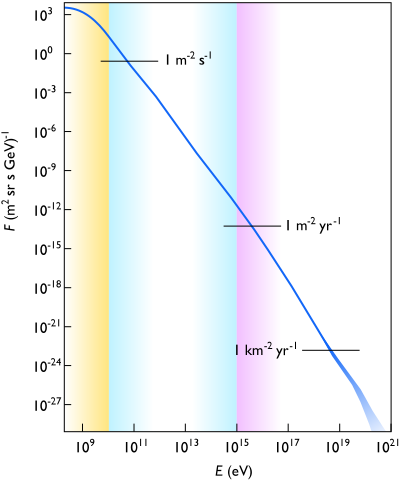
This diagram show the expected flux of cosmic rays as a function of their energy, assuming a power-law distribution. This is in fact what is observed. For example, cosmic rays with an energy of more than 1019 eV are observed at a rate of only 1 per km2 (of Earth surface) per year. So you need to observe over an area of many km2 simply to tally a reasonable number of the most energetic cosmic rays in a few years.

Because of the GZK effect, the flux of cosmic rays takes a sharp drop below the curve in the diagram right around 4×10¹⁹ eV. We still observe a very few cosmic rays with energies above that point, because if the cosmic ray originates from a source sufficiently close to Earth, there is still some nonzero probability it will not collide with a CMB photon. However, there is essentially no chance we will see a cosmic ray of more than 4×10¹⁹ eV if its souce is more than about 250 million light-years (Mly) from Earth.

As it turns out, this limit is actually a stroke of good fortune, because it means that in order to identify sources of UHECRs we need only consider objects within an Earth-centered sphere of radius 250 Mly. We can simply disregard objects that are farther away.

Another simplifying condition is that we don't need to bother with cosmic rays having an energy less than about 3×10¹⁹ eV, because the trajectories of such lower-energy cosmic rays are likely to have been deflected by our galaxy's magnetic field. We couldn't hope to identify the direction from which they came anyway. This is a useful simplification, since there is a larger variety of possible sources for the lower energy cosmic rays, and we would simply have too many possibilities to have a hope of correlating the observed directions with locations of particular source types. Furthermore, atomic nuclei larger than one proton will have more than one unit of charge, so they will also be deflected by the galaxy's magnetic field. And so we would not expect cosmic rays that don't consist of individual protons to have a correlation with the location of specific source objects.

Given all that, it's easy to understand and appreciate the result that was just announced early in November. The result comes from a large team working at the Pierre Auger Observatory in Argentina. The result, in a nutshell, is that out of 15 cosmic ray events with energy more than 6×10¹⁹ eV counted since 2004, 12 came from a direction that was within 3.1° of a known active galactic nucleus (AGN) within 250 Mly of Earth. It is calculated that the probability of this correlation occurring by chance is only about 1 in 1000 if the flux were isotropic.

What about the other 3 (of 15) events? They might have been cosmic rays that consisted of atomic nuclei heavier than a proton, and hence were deflected by galactic magnetic fields. However, these anomalous events were observed near the galactic plane, so their source could have been an AGN we cannot see because of dust in the galactic plane.

It should be mentioned that Auger is nothing like a typical optical observatory. Instead, it consists of a large number of instruments spread over an area of 3000 km2, which is about the size of Rhode Island. Yet since observations began in 2004, only about 80 events with energy more than 4×10¹⁹ eV were tallied, and there were only 27 with energy more than 5.7×10¹⁹ eV (a rate of about 1 per 4 km2 per century), so you can see how rapidly the numbers drop off in this range. Small wonder that cosmic ray astronomers now want to have an even larger observatory built, as well as to continue observations over enough years to reduce the possibility that correlations are due to chance.

Even so, the present results are generally considered to be pretty important – enough, anyway, to have become the cover story of the November 9 issue of Science. And this is even though the result is "only" a statistical correlation between directions of events and known AGNs. It's much too soon to say something like N events have been observed very close to a specific AGN. Also still left open is the construction of a model for exactly how UHECRs are produced in an AGN, let alone the validation of the model in a particular case (as has been done with lower energy cosmic rays and supernova remnants).

It's also only fair to note that objections to the Auger conclusions have been raised – see here, and in some of the references below.

However, we now have a lot better information about UHECRs than we had before.

More information:


Blog articles:


Tags: , , ,

Labels: , , ,

Tuesday, November 06, 2007

Massive Star's Afterlife: A Supernova Seeds New Planets

Massive Star's Afterlife: A Supernova Seeds New Planets
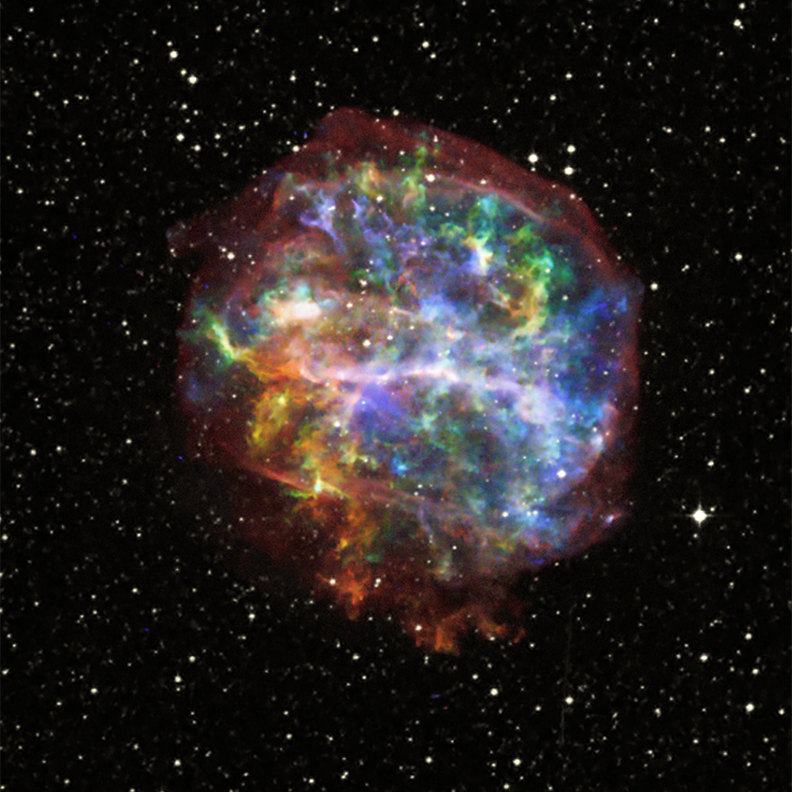
A spectacular new image shows how complex a star's afterlife can be. By studying the details of this image made from a long observation by NASA's Chandra X-ray Observatory, astronomers can better understand how some stars die and disperse elements like oxygen into the next generation of stars and planets.

At a distance of about 20,000 light years, G292.0+1.8 is one of only three supernova remnants in the Milky Way known to contain large amounts of oxygen. The image shows a rapidly expanding, intricately structured, debris field that contains, along with oxygen, other elements such as neon and silicon that were forged in the star before it exploded.


Supernova remnant G292.0+1.8 – click for 792×792 image


More: here

Labels: ,

Monday, November 27, 2006

High energy cosmic rays

Astrophysicists have wondered for a long time where cosmic rays come from, especially the most energetic ones.

A couple of recent research reports identify two different sources. The first of these is our old friend, Cassiopeia A:

Chandra discovers relativistic pinball machine

New clues about the origins of cosmic rays, mysterious high-energy particles that bombard the Earth, have been revealed using NASA's Chandra X-ray Observatory. An extraordinarily detailed image of the remains of an exploded star provides crucial insight into the generation of cosmic rays.

For the first time, astronomers have mapped the rate of acceleration of cosmic ray electrons in a supernova remnant. The new map shows that the electrons are being accelerated at close to the theoretically maximum rate. This discovery provides compelling evidence that supernova remnants are key sites for energizing charged particles.

This situation is described as a "pinball machine", because the electrons making up the cosmic rays (in this case) are accelerated by being bounced back and forth between magnetic fields and the expanding shock wave generated by the supernova:
"The electrons pick up speed each time they bounce across the shock front, like they're in a relativistic pinball machine," said team member Glenn Allen of the Massachusetts Institute of Technology (MIT), Cambridge. "The magnetic fields are like the bumpers, and the shock is like a flipper."

There are other accounts of this research here, here, and here.

Meanwhile, in another part of the universe, another team has identified a completely different source:

'Big bang gas' in cosmic particle-accelerator shock
Giant shockwaves around a distant cluster of galaxies could be generating some of the mysterious cosmic rays that strike Earth. They could also give us a clue as to why the universe is threaded with magnetic fields.

The cluster, called Abell 3376, is a swarm of galaxies about 600 million light years away. On either side of this swarm are two huge arc-like structures, each about 3 million light years across, that are sending out radio waves.

However, interestingly enough, apparently it is still the combination of magnetic fields and shock waves that is responsible for the particle acceleration – even though Cassiopeia A is 10,000 light years distant from us, while Abell 3376 is 60,000 times further away. The latter is also several million light years across, while Cassiopeia A is only about 10 light years wide. So there remains a major mystery about what produced such huge shock waves in Abell 3376:
Then what created the shocks in the first place? There are two possibilities. It may be that roughly a billion years ago, two clusters crashed into one another to form Abell 3376. The collision could have sparked a shockwave that travelled out through the cluster gas, whose remnants we are now seeing.

But there is a more intriguing possibility. Primordial gas, untouched since the big bang, should be constantly pouring into all galaxy clusters. Computer simulations of the cosmos show that gravity tends to pull the gas into stringy structures called filaments.

Abell 3376 could be threaded on one such filament, and the two shockwaves could mark where this cool ancient gas smacks into the super-hot gas of the cluster.

Other accounts of this research: here, here.


Tags: , ,

Labels: , , ,

Wednesday, November 22, 2006

NASA's Spitzer Peels Back Layers of Star's Explosion

NASA's Spitzer Peels Back Layers of Star's Explosion

Astronomers using NASA's infrared Spitzer Space Telescope have discovered that an exploded star, named Cassiopeia A, blew up in a somewhat orderly fashion, retaining much of its original onion-like layering.


Cassiopeia A – click for 800×800 image

Cassiopeia A, or Cas A for short, is what is known as a supernova remnant. The original star, about 15 to 20 times more massive than our sun, died in a cataclysmic "supernova" explosion relatively recently in our own Milky Way galaxy. Like all mature massive stars, the Cas A star was once neat and tidy, consisting of concentric shells made up of various elements. The star's outer skin consisted of lighter elements, such as hydrogen; its middle layers were lined with heavier elements like neon; and its core was stacked with the heaviest elements, such as iron.


Earlier (2004) press release on Cassiopeia A, with images: Deepest Image of Exploded Star Uncovers Bipolar Jets


Tags: , , ,

Labels: , ,

Saturday, September 09, 2006

Cassiopeia A - The colorful aftermath of a violent stellar death

Cassiopeia A - The colorful aftermath of a violent stellar death
A new image taken with NASA's Hubble Space Telescope provides a detailed look at the tattered remains of a supernova explosion known as Cassiopeia A (Cas A). It is the youngest known remnant from a supernova explosion in the Milky Way. The new Hubble image shows the complex and intricate structure of the star's shattered fragments.


Cassiopeia A - Click for 1280×921 image

Labels: , ,