Wednesday, February 24, 2010

Where have all the protons gone?

Astronomers have long known that there is a rather close relationship between the intrinsic luminosity of a spiral galaxy and the rotational velocity of stars (around the galactic center) in the outer portions of the galaxy. This relationship even has a name: the Tully-Fisher relation.

It has also been known that small, nearby dwarf galaxies, which are irregular in shape, are not nearly as bright as they "should" be, according to the Tully-Fisher relation, given the measured average velocities of their stars.

Recent research shows that, nevertheless, the Tully-Fisher relation can actually be extended, with slight modification, to very large structures: entire clusters of galaxies. In that case, the intrinsic brightness of a cluster is mostly in the X-ray part of the spectrum (because it's due to very hot intergalactic gas), yet the correlation of cluster brightness to the average velocities of galaxies in the cluster is still quite good.

There's actually a very good explanation for the correlation, in that intrinsic brightness and average velocity of constituents are both closely tied to the total mass of the object.

And this is where things get very interesting. One has to consider the mass of ordinary "baryonic" matter separately from the mass of non-luminous dark matter. Many different kinds of independent observations point to the existence of almost 5 times as much mass of the universe in the form of dark matter as there is in the form of ordinary matter. Stated differently, ordinary matter makes up only 17% (a bit more than 1 part in 6) of the total mass of matter in the universe.

As long as the intrinsic luminosity of an object is proportional to its total mass, then mass can be taken as a proxy for luminosity, and a relationship between total mass and average constituent velocity is to be expected. This relationship is in fact predicted even by Newtonian mechanics – total mass should be proportional to the 4th power of velocity (M ∝ V4).

If one could further assume that the ratio of mass in the form of ordinary matter to mass in the form of dark matter in a galaxy or cluster is the same as the ratio in the universe as a whole (1 : 5), then the Tully-Fisher relation makes perfect sense. And this is so even though luminosity is entirely produced by ordinary matter, not the invisible dark matter. Indeed, this holds up very well – for spiral galaxies.

Surprisingly, there is also a fairly good relationship between luminosity and average velocity even in galaxy clusters – but there's a slight difference in the exponent: M ∝ V3. Again, this holds regardless of whether one considers total mass (including dark matter), or just visible ordinary matter. (The mass of a large cluster can be determined independently by techniques such as gravitational lensing.)

It's customary to plot mass vs. velocity (on vertical and horizontal axes, respectively) with logarithmic scales on both axes. When this is done, one gets straight lines that have slopes of approximately 4 (for spiral galaxies) and 3 (for galaxy clusters).

However, when plotting visible mass vs. velocity, the relationship breaks down almost completely for nearby dwarf galaxies. The smallest and dimmest dwarf galaxies are far below the curve. Their visible mass and luminosity – not counting dark matter – is far too small. On a log-log plot, such galaxies fall, with quite a large scatter, around a straight line having a slope of 5 or more.

There's a simple way to restate this observation: dwarf galaxies have far less visible ordinary matter than predicted by a traditional Tully-Fisher relation, and even much less than that if the ratio of ordinary matter to dark matter in the dwarf galaxies were close to what it is in the universe as a whole. In most dwarf galaxies, the ratio is less than 1% of what it "should" be.

In other words, there's an awful lot of ordinary matter missing and unaccounted for in dwarf galaxies. Hence the question (since ordinary matter is mostly hydrogen (protons)): where have all the protons gone?

Observations of nearby dwarf galaxies are pretty reliable – these are our closest neighbors. Assuming Newtonian gravity, we know the masses of these objects very reliably from the velocities of the stars (which we can see individually) within them. There's no hot hydrogen in these galaxies, as there is in distant galaxy clusters, since we see no signal of it in any part of the spectrum down to the infrared. Astronomers are also pretty certain that there's not a lot of cold hydrogen, which should emit strongly at radio frequencies – the famous HI 21-centimeter line.

So where are all the protons? Quite possibly they've been blown outside of the dwarf galaxy entirely, by supernova winds. Escape velocity from a dwarf galaxy is a lot less than what it is for a typical spiral, yet supernovae have just as much bang as they do anywhere else. Very recent detailed simulations have supported this idea, as I discussed here.

An alternative, and rather more radical, possibility is that Newtonian gravity is wrong – the protons still aren't there (why?) but neither is any "dark matter". Instead, the total mass of visible stars – as surprisingly small as it seems to be – is still enough to account for observed stellar velocities, using some form of "modified Newtonian dynamics" (MOND).

Unfortunately, for believers in MOND, the theory was concocted as an alternative to dark matter for explaining rotational velocities in spiral galaxies. MOND theories are typically adjusted carefully to fit the spiral galaxy data. They would need to work differently in dwarf galaxies. And they are already known not to work right for large galaxy clusters either.

Lots of intriguing questions here...

Original abstract:

The Baryon Content of Cosmic Structures
We make an inventory of the baryonic and gravitating mass in structures ranging from the smallest galaxies to rich clusters of galaxies. We find that the fraction of baryons converted to stars reaches a maximum between M500 = 1012 and 1013 M, suggesting that star formation is most efficient in bright galaxies in groups. The fraction of baryons detected in all forms deviates monotonically from the cosmic baryon fraction as a function of mass. On the largest scales of clusters, most of the expected baryons are detected, while in the smallest dwarf galaxies, fewer than 1% are detected. Where these missing baryons reside is unclear.


ResearchBlogging.org
McGaugh, S., Schombert, J., de Blok, W., & Zagursky, M. (2010). THE BARYON CONTENT OF COSMIC STRUCTURES The Astrophysical Journal, 708 (1) DOI: 10.1088/2041-8205/708/1/L14


Further reading:

The Baryon Content of Cosmic Structures – preprint at arXiv

Team Shines Cosmic Light on Missing Ordinary Matter (1/7/10)

Dark Matter and Dark Energy Update (1/9/10)

Inventory Asks: Where Is All the Non-Dark Matter Hiding? (1/15/10)

Labels: , ,

Sunday, February 21, 2010

Dwarf galaxies start making sense

Cosmology has, for a decade, had its "standard model", which largely explains most of the cosmological phenomena that astronomers are able to observe. Except for a relatively small number of things that don't seem to make sense in the model. Prominent among the latter are dwarf galaxies – by one definition, galaxies having less than 10% of the total mass of the Milky Way.

The standard model of cosmology is known officially as the Λ-cold-dark-matter model – ΛCDM. (This theory has no particular relation to the Standard Model of particle physics.) Cold dark matter (CDM) refers to the hypothesis that a large part of the detectable mass content of the universe consists of particles that are not accounted for by the Standard Model of particle physics. The dark matter is said to be "cold", because it appears to consist mostly of "non-relativistic" particles, meaning particles moving at speeds not close to the speed of light. That excludes, for example, neutrinos.

As weird as the idea of dark matter might seem, there is abundant evidence for it, which can't easily be better explained in other possible ways. (Although, many other possibilities have been proposed.) I haven't written a lot about this recently, since the evidence for CDM just keeps piling up, but here's one important study. Dark matter is "observed" indirectly through its gravitational effects on ordinary visible matter. For instance, the motions of stars in the Milky Way have recently been analyzed closely enough to show that the dark matter in which the Milky Way is embedded has the shape of a squashed beach ball. (See here, here, here.)

Λ is the conventional symbol used for the "cosmological constant", which is a concept from Einstein's general theory of relativity. It is supposed to account for the observed phenomenon of "dark energy". This too is controversial, but there is much evidence for it, from a variety of different studies that are not all based on the same kinds of observations. I last wrote at length on the evidence here.

I need to write a lot more about recent evidence for dark energy, but I'll be very brief about it here. There is very recent evidence involving the motion of galaxies quite near our own (see here). Other than that, the evidence for dark energy is based on observations of distant Type Ia supernovae (about which there's a lot of recent news), "weak lensing" (see here), and "baryon acoustic oscillations" (a large topic).

In spite of all this evidence, ΛCDM isn't without its problems. As already suggested, one set of problems involves dwarf galaxies. There are at least two (somewhat related) parts to this problem. The larger part of the problem is simply that not enough very small dwarf galaxies (masses less than a percent of the Milky Way's) have been detected. This is often known as the "missing satellite problem".

Dwarf galaxies, being very small, are also intrinsically dim, and thus difficult to observe at all unless they're very nearby. However, only about 11 dwarf galaxies are known to be satellites of the Milky Way – and such satellites should be the easiest of dwarf galaxies to detect. This is a serious problem, since simluations of expected galaxies sizes based on the way that dark matter should be expected to clump together predict as many as 500 dwarf satellites of the Milky Way.

The other problem is known as the cuspy halo problem. "Halo" refers to the cloud of cold dark matter in which all visible galaxies are expected to be embedded. Simulations indicate that the dark matter should be concentrated in the center of the halo instead of being evenly distributed throughout. This is intuitively reasonable – after all, most of the ordinary matter in our solar system is concentrated right in the middle, in the Sun itself.

This problem exists somewhat even for large galaxies like the Milky Way, but it is much more severe for dwarf galaxies. In fact, it seems as though the smaller the galaxy is, the greater the tendency for the dark matter (as indicated by orbital motion of stars within the galaxy) to be distributed fairly smoothly, with little or no density cusp in the center.

Related to this is a recent finding (see here) that smaller galaxies seem to have a smaller proportion of ordinary baryonic matter to dark matter than does the universe as a whole. And, in fact, the smaller the galaxy, the smaller the proportion of ordinary matter. In the universe as a whole, there is much evidence, based on detected abundances of light elements and observations of the cosmic microwave background, that there should be about 5 times as much mass in the form of dark matter as there is of ordinary matter. One might expect this proportion to be about the same in galaxies. Yet instead, in the smallest galaxies, astronomers can detect less than 1% as much ordinary matter (in the form of visible stars) as one would expect to find.

This would suggest that an important reason we can't detect very many small galaxies is that they simply have too few stars and are too dim to see. But it still doesn't explain why this should be the case.

In fact, I wrote 2½ years ago about a study that reported finding many small galaxies consisting of 99% or more of dark matter (here). The authors of the study even speculated that the reason such galaxies were mostly composed of dark matter was that "the fierce ultraviolet radiation given off by the first stars, which formed just a few hundred million years after the Big Bang, may have blown all of the hydrogen gas out of the dwarf galaxies forming at that time." And they added, "The loss of gas prevented the galaxies from creating new stars, leaving them very faint, or in many cases completely dark. When this effect is included in theoretical models, the numbers of expected and observed dwarf galaxies agree."

Kind of makes sense, doesn't it? In fact, even for galaxies that began to form later, a large number of supernovae early in the life of a galaxy might be enough to blow away most of the hydrogen from which additional stars could form. And indeed, a recent much more detailed simulation of galaxy formation supports precisely this idea.

Why is it that previous simulations had not caught this? The reason is very simple: detailed simulations of galaxy formation and evolution are exceedingly demanding of computer resources. In order to make such simulations even possible – up until now – astrophysicists considered only the effect of gravitational collapse of a mixture of ordinary and dark matter. The effects resulting from star formation and subsequent supernovae were omitted entirely.

Duh.

Actually, this simplification is pretty understandable. The simulation that is the subject of the research under discussion here, that did take into account stellar formation processes, consumed an almost incredible amount of computing time. According to one report, "The simulation was carried out using about 250 processors running for about two months." That's more than 40 processor-years.

And that's just for one simulation, involving a single set of initial conditions.

Here's the abstract:

Bulgeless dwarf galaxies and dark matter cores from supernova-driven outflows
For almost two decades the properties of ‘dwarf’ galaxies have challenged the cold dark matter (CDM) model of galaxy formation. Most observed dwarf galaxies consist of a rotating stellar disk embedded in a massive dark-matter halo with a near-constant-density core. Models based on the dominance of CDM, however, invariably form galaxies with dense spheroidal stellar bulges and steep central dark-matter profiles, because low-angular-momentum baryons and dark matter sink to the centres of galaxies through accretion and repeated mergers. Processes that decrease the central density of CDM halos have been identified, but have not yet reconciled theory with observations of present-day dwarfs. This failure is potentially catastrophic for the CDM model, possibly requiring a different dark-matter particle candidate. Here we report hydrodynamical simulations (in a framework assuming the presence of CDM and a cosmological constant) in which the inhomogeneous interstellar medium is resolved. Strong outflows from supernovae remove low-angular-momentum gas, which inhibits the formation of bulges and decreases the dark-matter density to less than half of what it would otherwise be within the central kiloparsec. The analogues of dwarf galaxies—bulgeless and with shallow central dark-matter profiles—arise naturally in these simulations.

Basically what the simulation has to do is to incorporate a level of granularity that reflects the size of a typical star-forming region: "Baryonic processes are included, as gas cooling, heating from the cosmic ultraviolet field, star formation and supernova-driven gas heating. The resolution is such that dense gas clumps as small as 105 M are resolved, similar to real star-forming regions."

It certainly wasn't possible to do a simulation where the granularity was on the order of the size of a single star – that could take 105 times as long. Yet the results are very reasonable. The simulation produced a galaxy that closely resembles dwarf galaxies actually observed. In particular, the simulated galaxy has no "cusp" of dark matter density at the center, and no central bulge of visible stars in the center either.

And so the simulation adequately accounts for properties of real dwarf galaxies, which no previous simulation has done. The intense outflowing "winds" from supernovae that result from the heaviest initially-formed stars sweep all ordinary baryonic matter out of the central region. These winds are simply high-energy photons, which interact only with ordinary matter, not dark matter. However, the ordinary matter does interact gravitationally with the dark matter, which also then gets pulled away from the center.

The simulation does not directly settle the question of why so few very small dwarf galaxies are observed. Presumably, many small dwarfs actually do form. They just have so little ordinary matter that is able to coalesce into stars that the galaxies are too dim to detect at any great distance. This is in accord with other studies that show that the smallest galaxies have only a very small proportion of visible ordinary matter.


ResearchBlogging.org
Governato, F., Brook, C., Mayer, L., Brooks, A., Rhee, G., Wadsley, J., Jonsson, P., Willman, B., Stinson, G., Quinn, T., & Madau, P. (2010). Bulgeless dwarf galaxies and dark matter cores from supernova-driven outflows Nature, 463 (7278), 203-206 DOI: 10.1038/nature08640


Further reading:

Supernova winds blow galaxies into shape (1/13/10)

Supernovae put dark matter in the right place (1/13/10)

New research resolves conflict in theory of how galaxies form (1/13/10)

Astrophysicists unwind 'Cold Dark Matter Catastrophe' conundrum (1/14/10)

Puzzling Dwarf Galaxies Finally Make Sense (1/13/10)

Galaxy formation: Gone with the wind? (1/13/10)

Labels: , ,

Sunday, June 01, 2008

GLAST and gamma-ray astronomy

According to the present schedule, the GLAST gamma-ray telescope mission will be launched next week, on June 5, around noon EDT. If you're reading this before then, you can expect to find quite a bit of news coverage around that date. It's actually kind of a big deal, and I'll summarize some of the reasons for that here.

To begin with, you can find background information on the mission from NASA here and here.

In addition, there have been some good summaries already in science-oriented publications:

You can find good explanations of exactly what GLAST is in most of the above references.

What I'll summarize here are just some of the main objects and phenomena that GLAST is expected to help observe and study.

Gamma-ray bursts
Gamma-ray bursts (GRBs) have been discussed here several times, such as here and here. It is generally agreed that there are several different events that can cause a GRB, and a fair amount is known about the phenomenon already. For instance, the subtype known as a "long" GRB is thought to result from supernova explosions in which a high-energy jet of particles and radiation is emitted in a narrow beam that happens to point in our direction. But as yet we haven't measured the complete spectrum of energy from a GRB of any type. This spectrum can range from a few KeV to hundreds of GeV, and knowing it in detail would help determine the nature of the associated event much more accurately.

Dark matter
The visible universe that consists of luminous objects like stars and galaxies is composed of baryonic matter (mainly protons and helium nuclei). There may be at least as much baryonic matter in the form of diffuse gas that we cannot see. (Recent observations here and here.)

Yet it is essentially certain that the universe actually contains about four times as much matter that we can't detect at all (except by its gravitational effects) as all that baryonic matter put together. This is the dark matter. There are many theories about what this dark matter consists of, but in one of the main classes of theories, the matter consists of "weakly-interacting massive particles" (WIMPs). In most such theories, WIMPs can annihilate each other in pairs, giving off copious quantities of gamma-rays (among other things).

If some such theory accounts for a portion of the dark matter, GLAST will make it possible to estimate properties of WIMPs (e. g. their mass) by observing gamma-rays from locations where dark matter is expected to be concentrated, such as in the center of the Milky Way. This kind of information will complement and help corroborate observations made at the Large Hadron Collider, in which some kinds of WIMPs (if they exist at all) are expected to be created.

Solar gamma-rays
Although our Sun is a relatively weak source of gamma-rays compared to almost everything else mentioned here (even weaker than the Moon, where gamma-rays are produced when cosmic rays strike the surface), several solar events, such as flares and coronal mass ejections do produce gamma-rays. So GLAST will help us better understand solar events of this kind.

Supernova remnants
A large class of gamma-ray bursts are associated with the initial blast of a supernova event, and the gamma-rays from such bursts subside in a matter of minutes. But other gamma-rays may originate by other mechanisms from the supernova remnant long after the original event. Gamma-rays are thought to be produced in such remnants due to particles being accelerated to high energies in the blast and subsequently generating shock waves in the interstellar medium. The shock waves themselves are reasonably well understood, but how the particles are actually accelerated by the supernova blast needs much more elucidation, which GLAST can provide.

Pulsars
Another part of the remnant left over after a supernova is either a stellar-mass black hole, or else a rapidly spinning neutron star. Such a neutron star will produce jets of electromagnetic energy, usually at radio frequencies, and when the Earth is lined up with the jet the object is called a pulsar. These also emit gamma-rays. Since neutron stars are extremely small and dense, they have intense magnetic fields near their surface, and the fields reveal a lot about the nature of matter in the neutron star. The strong fields also convert gamma-rays into electron-positron pairs, so the overall gamma-ray spectrum can give us information about the object's magnetic fields, and about surface features that cause gamma-ray emission.

Supermassive black holes, active galactic nuclei, quasars, blazars
Supermassive black holes are thought to exist at the centers of most or all galaxies. We can estimate that they have masses ranging from 105 to 1010 solar masses, yet there is a great deal more we would like to know about them, such as the process by which they form. (See here.) Most supermassive black holes are thought to be circled by an accretion disk of matter which has been attracted by the object's extreme gravity.

Depending on the amount of matter in the disk, large amounts of energy may be released as the matter falls into the black hole. Our own Milky Way has a smallish object of this sort, with a correspondingly small accretion disk. But if there is much more mass in the disk, one has a bright object called an active galactic nucleus (AGN). AGNs were more plentiful in the early days of the universe, before most of the available nearby matter had been consumed by the black hole, and especially active objects of this kind, usually at great distances, are called quasars.

Like supernovae (from which stellar-mass black holes or neutron stars are formed), supermassive black holes may emit powerful relativistic jets of particles and energy. If such a jet is pointed in our direction, we see an especially bright source, called a blazar. Most of the emitted electromagnetic energy from all these objects is in the gamma-ray part of the spectrum.

So one of the main objectives of GLAST is to measure how this spectrum varies over time, in order to get a better understanding of what is actually going on. For instance, there could be additional confirmation of a model of the relativistic jets as described in this recent research, and perhaps evidence as to whether the particles in the jets are protons or electrons.

Cosmic ray origins
As discussed in detail here, we are finally beginning to clear away some of the mystery surrounding the most energetic ultra-high-energy cosmic rays (UHECRs). But there's a lot more we'd like to know, such as whether these rays are mostly made up of relativistic protons, and what sort of process creates them in the first place. Gamma-rays are produced when UHECRs interact with interstellar gas and dust, so GLAST may be able to give us more information about UHECRs.

Primordial black holes
It is generally suspected that many small black holes (with masses covering a wide range, but much less than the mass of a star) could have been produced in the big bang. These are called primordial black holes. Their existence hasn't yet been confirmed. But Stephen Hawking made a strong case that any black hole will slowly emit weak electromagnetic radiation, due to quantum effects and called Hawking radiation. This radiation should be too weak to be directly observable. However, small primordial black holes should eventually evaporate completely by this process, and at the end disintegrate in a burst of gamma-rays. This is all rather conjectural, but if it happens, it may contribute to a continuous gamma-ray background that can be detected.

Cosmic gamma-ray background
In addition to discrete gamma-ray sources such as GRBs and supernova remnants, there is a diffuse background of gamma-ray photons, much like the cosmic microwave background (CMB), only vastly more energetic. Some of this background may be due to UHECRs, very distant and very powerful (TeV range) gamma-ray sources, or primordial black holes. But who knows what other kinds of sources might be out there? There will probably be some surprises, as well as a lot of useful information to be deduced, just as happened with the CMB.

Possible breakdowns of special relativity
Heading even further into speculative territory, various theorists of quantum gravity have proposed that even special relativity (as well as general relativity too) may break down under various conditions. For example, the speed of light might not be an exact constant, but might instead vary by a slight amount according to the energy carried by individual photons.

Thus not all gamma-ray photons from a GRB would need arrive at precisely the same time, and so any pattern in this radiation would be shifted very slightly depending on what part of the gamma-ray spectrum is observed. Even if the shift is as little as 1/1000 of a second (for photons that may have been travelling for billions of years), GLAST should be sensitive enough to detect the shift. That would certainly be quite a surprise if found.


Further reading:

GLAST Science Writer's Guide – An extremely informative 47-page document (PDF), with detailed descriptions of the relevant science, a glossary, and additional links

Simona Murgia: Dark Matter searches with GLAST – Blog posting that discusses the relevance of GLAST for dark matter searches

Tags: , , , , , , ,

Labels: , , , , , , , ,

Sunday, November 04, 2007

Readings: Cosmology and astrophysics, 4 November 2007


The text following each item is quoted material, except for editorial comments, which are in color.


FSU physicist shining a light on mysterious 'dark matter'
"Recent scientific breakthroughs have shown that most of the matter in the universe—about four-fifths—is not made up of atoms, but of something else, called 'dark matter,'" said Howard Baer, FSU's J.D. Kimel Professor of Physics. "The evidence for dark matter is now overwhelming, and the required amount of dark matter is becoming precisely known." ...

A theoretical physicist, Baer employs mathematical models and calculations, as opposed to experimental methods, in an attempt to understand the basic properties of dark matter. To that end, he travels frequently to CERN, the world's largest particle physics laboratory, located on the border between France and Switzerland. At CERN, teams of physicists from all over the world are preparing for the start-up of what will be the world's most powerful particle accelerator, the Large Hadron Collider (LHC), in 2008. With the LHC, they will conduct experiments that seek to solve some of the fundamental mysteries of science, including the identity of dark matter. In addition to searches at the LHC, the hunt for dark matter is progressing at experiments deep underground in Minnesota, under thick Antarctic ice, and even in outer space.

Another piece in the dark matter puzzle
“We took one specific theory about dark matter,” Riemer-Sørensen explains. “We look at a specific type of decaying particles, and if they represent dark matter, they will decay and transform into photons in x-rays.” The particles in question are axions, hypothetical elementary particles used in theories describing “extra” dimensions. The idea, she says, is to look for an area of the universe that has a great deal of dark matter, and then look for weak x-ray emissions. ...

So, did Riemer-Sørensen and her colleagues find the weak dark matter x-ray emissions? “We didn’t find any clear signs of x-ray emissions from axions in these regions,” she says. “And that tells us something about dark matter.” If dark matter particles do follow the reactions of decay set forth in the theory of axions as dark matter, then dark matter has an extraordinarily long lifetime. “If dark matter does decay,” Riemer-Sørensen insists, “then the lifetime of the axions is at least three million billion years, which is twenty thousand times longer than the lifetime of the universe.”

Can this experiment identify dark matter?
“Many experiments and observations all point to the existence of some form of matter that is different from the ordinary matter that makes up starts, planets and even people,” Bertone explains. Because dark matter is so prevalent in the universe, many scientists are interested in better understanding its role in fundamental physics, as well as the formation of the universe. “There are efforts to clarify the nature of dark matter.”

Bertone explains that there are three main approaches to detecting dark matter particles, which are likely to be weakly interacting massive particles (WIMPs). The first, he says, is an earthbound method using particle accelerators, like the Large Hadron Collider due to go online at CERN next year. “Scientists hope to find particles in accelerators that could be like the dark matter found in the rest of the universe.”

The next method of detection is one of indirect observation. Looking out into space, Bertone says, scientists “look for some signal due to interaction of particles amongst themselves.”

The strategy set forth in the article belongs to the third approach, which is to build a large detector and wait for a dark matter particle to interact with ordinary matter. “To show the power of this technique, we focused on an experiment called COUPP [Chicagoland Observatory for Underground Particle Physics]” Bertone says. “It is a bubble chamber, much like what has been used before in other fields.”

In the dark: science still mystified by stuff of universe
Most of the universe -- 96 percent, to be exact -- is made of dark matter and energy whose composition we simply do not fathom, a Nobel laureate told physicists gathered this week to explore the intersection of the infinitely small and the infinitely large. ...

Most physicist attending the conference here on astroparticle physics think the basic ingredient is probably some as-yet undiscovered elementary particle, a relic of the "Big Bang" that created the Universe around 13 billion years ago.

The favored candidate is the neutralino, a "supersymmetric" particle whose existence has yet to be proven. But the hunt in underway, using both direct and indirect methods, including experiments to be conducted at the Large Hadron Collider (LHC) in Switzerland.

Over the next decade, explained Katsanevas, scientists will be tackling three big questions besides dark matter: the origin of cosmic rays, the existence of gravitational waves, and the mass of neutrinos, which have provided the first solid evidence of phenomena beyond what is called the Standard Model of particle physics.

Astronomers Aim to Shine Light on Universe's 'Dark Energy'
In nearly a decade since it was discovered, a mysterious cosmic feature dubbed "dark energy" has lain like a downed redwood across the path of scientists trying to reach the holy grail of physics – a fundamental theory of matter and its basic forces. ...

"After about 10 years it's clear [dark energy] is not going away.... We have to really figure out what this is," Riess says. The past decade also has shown that "dark energy lives at the crossroads of two of our best theories of physics: quantum mechanics and general relativity."

A successful marriage of quantum theory and gravity is the last major hurdle in demonstrating that the basic four forces of nature – gravity, electromagnetism, and weak and strong forces that operate at the subatomic level – are manifestations of a single force that dominated the universe in the first few fractions of a second after the big bang. With dark energy, "nature is giving us a hint of how it does quantum gravity," Riess says.

Hubble Telescope: Solved and Unsolved Mysteries
Beyond snapping extraordinary pictures of faraway nebulas, the revolutionary Hubble Space Telescope has completely transformed our view of the universe since it was launched in 1990. By capturing the clearest, deepest images of the cosmos ever, Hubble has shed light on some long-standing mysteries perplexing scientists-while uncovering far deeper ones that have yet to be solved. ...

Dark energy has prompted new theories regarding the origin of the universe, such as one where clashing membranes of reality trigger endless cycles of cosmic death and rebirth, as well as the fate of the universe, raising the possibility that dark energy ends the universe in a Big Rip. Future progress on understanding dark energy's nature will likely require a dedicated dark energy space mission, "for sometime in the middle of the next decade, perhaps," Leckrone said.

The other mysteries mentioned in the article involve dark matter, gamma-ray bursts, direct imaging of extrasolar planets, and protoplanetary disks. These are all issues which can be studied by more or less conventional optical or infrared telescopes – much like Hubble, only more powerful. There is also a need for a more powerful ultraviolet-sensitive telescope, which is not currently even part of NASA's agenda. Although the descriptions of the "mysteries" in the article are sketchy, there are links to additional information.

Is the universe a doughnut?
Later work by Neil Cornish of Case Western University, David Spergel of Princeton University, and Glenn Starkman of the University of Maryland extended this technique to consider a wider range of possible topologies. Such a method has been applied to the WMAP results, examining the possibility that it could have a complex topology— not a toroid perhaps, but rather a dodecahedron (a bit like a soccer ball, but with all sides equivalent in size and shape). Although preliminary data (analysed in 2003) seemed to rule out this model, more recent looks at the WMAP findings have revived the idea that if you venture far enough out into space you'll return to your starting point. Hence Homer's doughnut theory may have at least a sprinkling of truth: the universe could indeed have loops.

This is a pretty good article for an overview of the shape of the universe, in spite of its facetious premise (that a cartoon world can be effectively used to explain highly technical cosmology). The genre, of popular TV shows used as points of embarcation into explanations of scientific topics, is growing. First there was The Physics of Star Trek, which is not too surprising a connection. But The Physics of the Buffyverse? And now, in effect, physics according to Homer Simpson? Having read only the first of these, I don't know that these aren't all quite good books. But what this trend says about our culture... I don't really want to go there.

However, if Robert Gilmore can write physics books based on such metaphorical worlds as those of Alice in Wonderland, The Wizard of Oz, A Christmas Carol, or Grimms' Fairy Tales, ... well, why not? Perhaps we need someone to write books of physics based on The Odyssey or The Divine Comedy? And while we're at it, let's not leave out the physics of the Niebelungenlied and the Mahabharata. I can hardly wait.


Why the Universe is All History
Some galaxies are so remote that their light hasn't had sufficient time to reach us yet, despite about 13.7 billion years of travel. There could also be more distant objects that will forever remain unknown to us.

"Because the universe is expanding and the expansion appears to be accelerating, there may be distant galaxies which if we can't see them now because their light has not had time to reach us, we will never see," Stecker said.

So we can never see the universe as it is, only as it was at various stages of its development.

New-School 'Aether' May Shed Light on Neutron Stars
Among scientists, it is widely believed that there is no such thing as an aether – a medium pervading all space that allows light waves to propagate, similar to how sound needs air or water – but a part of its spirit may live on. A group of University of Maryland (UM) physicists have proposed a modern spin on the aether of old and have used it to make new predictions about the behavior of neutron stars. ...

The UM researchers – Christopher Eling, Ted Jacobson, and Coleman Miller – describe their aether as a preferred state of rest at each point of spacetime. This preferred state would not be the result of something known, such as a gravitational field or cosmic background radiation, but may, they say, arise from the structure of empty space in quantum gravity theory. ...

The UM team use the new aether to make concrete predictions about neutron stars that differ from those generated by general relativity, Einstein’s theory of gravity. The group's calculations show that the maximum mass of neutron stars would be smaller than in general relativity and the increase in wavelength, or “redshift,” experienced by photons emitted from the stars' surfaces must be 10 percent larger.

Predicting Planets
Discovering new planets that orbit distant stars has become commonplace. But now a team of astronomers has managed to predict the orbit of an extrasolar planet — before anyone knew for certain that it existed. The last time that happened was more than 150 years ago. ...

The more-recently discovered planet is known by a rather-less-elegant name: HD 74156d. It is a gas giant, slightly more massive than Saturn, orbiting a sun-like star about 65 parsecs (212 light-years) away. Its orbit was predicted in 2004 by Rory Barnes and Sean Raymond, theoretical astronomers then at the University of Washington in Seattle. Three years later, Jacob Bean, an astronomer now at the Georg-August-Universitaet in Goettingen, Germany, announced that he had found the planet, pretty much where Barnes and Raymond said it would be.

Lonely Planets of the Cosmos
A brief letter in Nature was John Debes's inspiration. The 1999 piece, by David J. Stevenson (Caltech), proposed that planets with liquid water oceans — and even life — could exist in the cold, dark depths of interstellar space far from any star. Based on the knowledge that some fraction of planets must get gravitationally ejected from their systems during the systems' formation, the paper theorized that some of these ejected planets could, with enough internal heat, keep their atmospheres and stay warm enough to support liquid water below a thick frozen crust.

What might happen if such an outcast had a big moon? To find out, Debes (at the Carnegie Institution of Washington) ran 2,700 computer simulations based on an Earth-mass planet and a lunar-mass companion.

The Enduring Mysteries of the Sun
The sun lies at the heart of our solar system, but it still holds back many secrets from science. Unlocking these mysteries could shed light on puzzling activity seen in other stars and even safeguard lives.

It's surprising how much we don't understand about stars – from either theory or observation – considering that we live so close to one.


Tags: , , ,

Labels: , , , , , ,

Thursday, October 04, 2007

Dwarf galaxies

Smallest Galaxies Ever Seen Solve a Big Problem
Mauna Kea scientists may have solved a discrepancy between the number of extremely small, faint galaxies predicted to exist near the Milky Way and the number actually observed. In an attempt to resolve the “Missing Dwarf Galaxy” problem, two astronomers used the W. M. Keck Observatory to study a population of the darkest, most lightweight galaxies known, each containing 99% dark matter. The findings suggest the “Missing Dwarf Galaxy” problem is not as severe as previously thought, and may have been solved completely.

“It seems that very small, ultra-faint galaxies are far more plentiful than we thought,” said Dr. Marla Geha, co-author of the study and a Plaskett Research Fellow at the Herzberg Institute of Astrophysics in Canada. “If you asked me last year whether galaxies this small and this dark existed, I would have said no. I’m astonished that so many tiny, dark matter-dominated galaxies have now been discovered.”

I don't really have a lot to add to this, except to remark that this is probably a more significant result than may be immediately obvious. After all, so a lot of tiny, lightweight galaxies have been found in orbit around the Milky Way – so what?

The significance is that this observation goes a long way towards solving a problem with the hypothesis that the universe contains large amounts of "cold dark matter" – perhaps 4 times as much mass in the form of "dark matter" than there is in the form of more ordinary "baryonic" matter. There is already a huge amount of evidence for the existence of dark matter, as discussed here and here.

The problem is that simulations which have been done on the evolution of galaxies under the assumption of a ratio of 4:1 dark matter to baryonic matter predict the existence of many more small "dwarf" satellite galaxies around the Milky Way than are actually observed. Intuitively, one would expect many small galaxies, since if visible galaxies consist of stars made of baryonic matter inside blobs of dark matter, there ought to be a large range of sizes, from the smallest to the largest. Instead, what has been observed until now is far too few of the smallest sizes.

The solution suggested by the results here is that galaxies that formed inside the smallest blobs of dark matter have far fewer stars than would be expected, and hence they are intrinsically dim and hard to detect, so that most very small galaxies simply haven't been noticed.

But why would such galaxies have so few stars? This question remains to be answered, but a plausible hypothesis is that most of the gas of these galaxies, from which stars could form, may have been literally blown away by the intense light radiated by the first very large stars that formed in the Milky Way itself:
Based on the masses measured for the new dwarf galaxies, Drs. Simon and Geha concluded the fierce ultraviolet radiation given off by the first stars, which formed just a few hundred million years after the Big Bang, may have blown all of the hydrogen gas out of the dwarf galaxies forming at that time. The loss of gas prevented the galaxies from creating new stars, leaving them very faint, or in many cases completely dark. When this effect is included in theoretical models, the numbers of expected and observed dwarf galaxies agree.

“One of the implications of our results is that up to a few hundred completely dark galaxies really should exist in the Milky Way’s cosmic neighborhood,” said Dr. Geha. “If the Cold Dark Matter model is correct they have to be out there, and the next challenge for astronomers will be finding a way to detect their presence.”


Other reports on this research: here, here

Preprint of the research paper: The Kinematics of the Ultra-Faint Milky Way Satellites: Solving the Missing Satellite Problem

Preprint of a subsequent research paper describing how dark matter content of very faint dwarf galaxies might be confirmed: The Most Dark Matter Dominated Galaxies: Predicted Gamma-ray Signals from the Faintest Milky Way Dwarfs

Tags: ,

Labels: , ,

Wednesday, August 29, 2007

Dark Matter Mystery Deepens

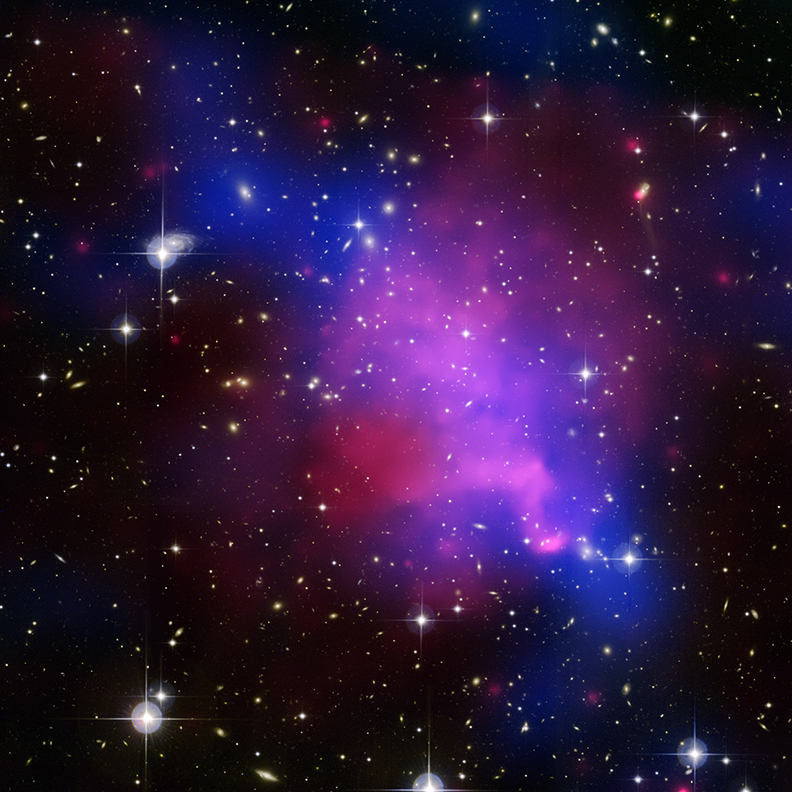
Dark Matter Mystery Deepens in Cosmic "Train Wreck"
This multi-wavelength image of Abell 520 shows the aftermath of a complicated collision of galaxy clusters, some of the most massive objects in the Universe. In this image, the hot gas as detected by Chandra is colored red. Optical data from the Canada-France-Hawaii and Subaru telescopes shows the starlight from the individual galaxies (yellow and orange). The location of most of the matter in the cluster (blue) was also found using these telescopes, by tracing the subtle light-bending effects on distant galaxies. This material is dominated by dark matter.


Abell 520 – click for 792×792 image


Additional information: here, here, here, here, here

Labels: ,

Tuesday, July 17, 2007

Axions

There's been a bit of news recently about axions.

But first, what is an axion, and why should anyone care? Don't we have enough oddball particles already? Perhaps we do, but regardless of that, the properties axions are hypothesized to possess would be a good fit for what is needed in a particle that could make up at least some dark matter.

Specifically, the theory behind axions predicts that they would be rather light, but not massless – between 10-6 and 10-2 eV/c2. For comparison, the mass of an electron is about 510,999 eV/c2. On the other hand, neutrinos (all three types) are known to have mass, and though this mass isn't well determined, axions would be in the same range.

Just as axions interact very weakly with gravity, they should interact very weakly, if at all, with the weak and strong nuclear forces. In particular, axions should have no electric charge. These properties make them good dark matter candidates, unlike neutrinos, which do feel the weak force.

On the surface, the most recent news, concerning the failure of an experimental attempt to detect axions, appears to be discouraging. But the silver lining is that if the experiment had actually detected axions, it would imply that they couple too strongly to photons to be a dark matter candidate. For that reason, this failure has been greeted with a bit of relief.

You see, one other expected property of axions is that in the presence of a strong magnetic field, axions could transform into photons, or vice versa. This makes it possible to design certain experiments for detecting axions, as we shall see.

Theoretically, the reason axions were predicted to exist in the first place has to do with breaking of charge-parity (CP) symmetry by the strong nuclear force. Or rather, the apparent failure of CP symmetry breaking by the strong force.

CP symmetry breaking was first discovered in 1964 in connection with the weak force. Even there, the effect is small, but by now it has been verified and measured repeatedly. Quantum chromodynamics (QCD) is the quantum field theory of the strong force, and it is similar enough to the theory of the weak force that there is no apparent reason CP symmetry breaking isn't observed with the strong force.

There is a parameter in the equations called θ which describes the amount of symmetry breaking. To accord with experimental results, θ must be fine-tuned to be extremely close to 0, even though it could have any value from 0 to 2π. Physicists do not like such fine tuning, and so they have given the name "strong CP problem" to the lack of CP breaking by the strong force, or alternatively the smallness of θ.

The solution to this problem that has been most popular with physicists is based on what is called the Peccei-Quinn mechanism, after Roberto Peccei and Helen Quinn, who were both at Stanford in 1977 when they came up with theory. (Trivia note: I sat in on a quantum field theory course given by Peccei in 1974. As I was in mathematics, it didn't make a whole lot of sense to me then, what with all the Feynman integrals and such flying around, oblivious to their lack of rigorous mathematical definition. I also recall the class meeting in November 1974 when the discovery of the J/Psi particle was announced. I didn't understand what all the exceitement was about, either. Future astronaut Sally Ride, then a physics grad student, was also in the class.)

Anyhow, the Peccei-Quinn proposal was to make this parameter θ into a quantum field (meaning it could have different values at different points). Along with this field, there should be a new global symmetry (Peccei-Quinn symmetry) that, however, is spontaneously broken. As Frank Wilczek and Steven Weinberg then showed, this implies the existence of a particle – which Wilczek called the axion, because it "cleaned up" the theory. (Axion was the name of a popular brand of laundry soap.) They also showed this would be a satisfactory solution to the strong CP problem.

It would be even more satisfactory if experiments could actually detect axions. But in the 30 years since then, this has not happened.

That basically brings us to the latest news about axions. Because axions and photons can turn into each other, it turns out that if a beam of polarized light is passed through a strong magnetic field a small rotation in the direction of polarization should occur, due to interaction of the photons with the magnetic field, creating real or virtual axions.

The PVLAS laboratory in Italy has been conducting such an experiment for several years. For awhile the reasearchers thought they has obtained positive results. Sadly, no. Just a couple weeks ago the researches reported their earlier results couldn't be reproduced:

Axions ruled out by PVLAS

The existence of a hypothetical particle called the axion has been put into further doubt now that the team that first claimed its discovery has failed to reproduce their results. Physicists working on the PVLAS experiment in Italy say that the tiny rotation in the polarization of laser light that they reported last year does not support the existence of axions, but rather is an artefact related to how the experiment had been performed.

But the silver lining is:
The latest news from Italy should come as a relief to physicists who believe that axions could make up dark matter. This is because the PVLAS axion appeared to couple too strongly to light to be a suitable candidate for dark matter.


Tags:

Labels: , , ,

Sunday, October 08, 2006

No Extra Gravity for Dark Matter

Considering that there's no way to actually "see" dark matter directly, it's impressive that more is being learned about it all the time. Now we've found that it experiences the force of gravity to the same degree as ordinary matter, with an error of no more than 10%:

No Extra Gravity for Dark Matter
The Milky Way is gradually pulling apart a smaller orbiting neighbor known as the Sagittarius dwarf spheroidal galaxy. Just as gravity from the moon causes Earth's oceans to bulge, so too does the gravity of the Milky Way create enormous tides that deform Sagittarius. These are so strong that they rip stars out of the galaxy, producing two long streams of stars, one stretching ahead of Sagittarius and one lagging behind. By observing the stars streaming out in both directions, the researchers conclude that the dark matter and ordinary matter within the smaller galaxy feel the same pull from the Milky Way.


Update (10/11/06): This observation is quite analogous to the (probably apocryphal) story of Galileo dropping objects of different materials and densities from the tower of Pisa. Since the objects take the same time (neglecting air resistance) to fall, this shows that gravity exerts the same force regardless of the type of matter it is acting on.

Additional information:

How Fast Does Dark Matter Fall?

Tags: , ,

Labels: ,

Monday, August 21, 2006

NASA Finds Direct Proof of Dark Matter

I've written about dark matter a number of times, most recently here. A more extensive article is here.

The gist of things is that, although there has been much indirect evidence for dark matter, there have also been many skeptics, both among astrophysicists and in the general public.

Uncomfortable with the idea of dark matter as a postulated solution to a number of astrophysical puzzles, the skeptics have devised a number of alternative explanations for the various anomalies -- often by attempting to modify long-accepted principles of Newtonian gravity and general relativity.

But heedless of the skeptics, evidence for dark matter just keeps piling up. Here is the latest, just released today, and it is a lot less indirect than previous evidence:

NASA Finds Direct Proof of Dark Matter
Dark matter and normal matter have been wrenched apart by the tremendous collision of two large clusters of galaxies. The discovery, using NASA's Chandra X-ray Observatory and other telescopes, gives direct evidence for the existence of dark matter.

"This is the most energetic cosmic event, besides the Big Bang, which we know about," said team member Maxim Markevitch of the Harvard-Smithsonian Center for Astrophysics in Cambridge, Mass.

These observations provide the strongest evidence yet that most of the matter in the universe is dark. Despite considerable evidence for dark matter, some scientists have proposed alternative theories for gravity where it is stronger on intergalactic scales than predicted by Newton and Einstein, removing the need for dark matter. However, such theories cannot explain the observed effects of this collision.


For more commentary, see this at particle physicist Clifford Johnson's Asymptotia.

Tags: ,

Labels: ,

Wednesday, June 21, 2006

It's all relative

In the previous message we mentioned an interesting article on relativity: Relativity at the centenary, which pointed out that gravitational physics has become an experimental science. There's a lot going on with studies of black holes, the search for gravitational waves, detailed tests of special and general relativity. And on the theoretical side, there's a lot of activity in the (as yet still unsuccessful) quest for a theory of quantum gravity.

Of course, the theory of relativity is intimidating to a lot of people, but it doesn't need to be. Special relativity actually involves little more that basic physics (ideas like mass, velocity, force, energy) and high school algebra with rudimentary calculus. The mathematics needed for general relativity is somewhat more sophisticated. But the basic concept described by the math is pretty simple: concentrations of matter cause space to curve, and the motion of two (or more) massive objects that interact gravitationally can be understood as "straight lines" in the curved space.

Once you've read some overviews, like the Wikipedia articles just referred to, you will have the basic ideas needed to learn more about relativity. Fortunately, there's an excellent online reference with a large number of review articles that explain in more detail many of the most interesting topics in the contemporary theory of relativity. It's called Living Reviews in Relativity -- and it's all free.

The journal, which covers both theory and experiment, is now in its 9th year. Some of the articles are valuable for understanding basic topics in cosmology. Here are some of the more generally accessible articles:


Note that there have been updated versions of some articles. In each case, only the most recent update (as of this writing) and its corresponding date are listed.

Tags: , , , , ,

Labels: , , , , , , , , ,

Tuesday, October 25, 2005

The universe, dark matter, and everything

It all fits together.

Over the years, there have been many skeptics of what is currently the consensus theory -- the big bang -- of how the universe evolved from a very hot, very dense state about 13.7 billion years ago to its current stage. In the 1950s and early 1960s, an alternative -- the "steady state theory" -- briefly flourished. But, in the view of most cosmologists, this alternative took a fatal hit in 1964 with the discovery of the cosmic microwave background (CMB).

Nevertheless, a handful of big bang skeptics have persisted until the present day. Some argue, for instance, that the spectral red shifts that are generally presumed to be due to a relatively simple relationship between the distance of an object and its velocity relative to the Earth could in fact be explained by some other means.

Unfortunately for the skeptics, there is more than one type of evidence for the big bang theory. For example, measurements of the relative abundance of a few light isotopes of hydrogen, helium, and lithium are very consistent with predictions of the big bang theory on the basis of the process of cosmic nucleosynthesis of these isotopes. The steady state model has no obvious explanation for this consistency, because the predictions rest on the universe being in a very hot, dense state in which the isotopes were created about 5 minutes after the big bang.

An even deeper problem for the skeptics is that just about everything we have observed about the distant universe -- things like the expansion rate at different times, the apparent existence of "exotic" dark matter, and various detailed properties of the CMB -- all fit very nicely and neatly in the big bang theory, like the pieces of a mechanical puzzle. There is no alternative theory that explains even one of these features well, let alone all of them.

Suppose you took all the observational evidence we have regarding dark matter, the CMB, and so forth and combined all that with the theoretical assumptions behind the big bang model in order to make a detailed computer simulation of the evolution of the universe. This would be much like the way the behavior of hurricanes, say, can be simulated from what we know about the circulation of the atmosphere, ocean currents, and basic gas dynamics. Would such a simulation of the universe on a computer predict various additional features of the universe we can actually observe? Most importantly, things like the way galaxies and clusters of galaxies are distributed in space and the kinds of objects we can observe at very great distances, such as quasars and very young galaxies.

A very detailed simulation of this kind has recently been constructed and run. The results of this Millennium Simulation were announced in June of this year. (News stories here, here, here.)


An image from the 3-dimensional visualization of the Millennium Simulation


Then in August a nice article by Ron Cowen appeared in Science News -- Cosmic Computing: Simulating the universe

Basically, what any simulation allows you to do is to derive consequences and predictions that follow from given theoretical assumptions and observational data. The computer allows making numerical predictions and (sometimes) presenting them in viusal form, even when exact solutions of the underlying equations aren't known. And when the observational data is only approximate, it is possible to figure out the consequences when the data is varied, in order to determine what produces the best fit with other observations.

Here are some of the most noteworthy findings:

  • Temperature and density fluctuations in the CMB are markers for the distribution of dark matter, and as this distribution participates in the expansion of the universe, it leads to a distribution of galaxies and clusters of galaxies which is very consistent with what has been determined by large-scale galaxy surveys, especially the Sloan Digital Sky Survey and the Two Micron All Sky Survey.
  • The model confirms that the expansion of the universe is accelerating, implying the existence of some sort of dark energy.
  • Supermassive black holes and quasars could have evolved in the universe very early. Some extremely bright quasars that existed about 870 million years after the big bang must have been powered by black holes with the mass a billion times the mass of our sun.
  • The simulation shows that such supermassive black holes could have formed that early, because they would have grown more quickly in unusually dense regions of the early universe. They would also have become the cores of supermassive galaxies which can now be observed at the centers of the largest galaxy clusters.
  • Galaxies form in a bottom-up rather than top-down manner -- they start out small and grow as they capture more matter, instead of by the splitting of larger aggregations of matter. Eventually larger elements of a structure hierarchy develop -- galaxy clusters and then clusters of clusters.
  • Clusters of galaxies form within dense regions of dark matter known as halos. Among halos having the same mass, the ones that formed earliest have the densest clusters of galaxies. Hence old galaxies cluster more stongly than newer ones. That is, clusters of galaxies are denser if they formed earlier, as well as if the halo in which they formed is itself denser. (See The age dependence of halo clustering.)
  • About 85% of gravitating matter in the universe must be in the form of non-baryonic "exotic" dark matter in order for the simulation to be consistent with observations.


------------------------

References:

The Virgo Consortium - research group responsible for the Millennium Simulation

The Big Bang

------------------------

Tags: , ,

Labels: , ,

Wednesday, October 19, 2005

Revisiting the evidence for dark matter

Recently, the CERN Courier, a usually reliable source, came out with this article: General relativity versus exotic dark matter.
Determinations of the rotation speed of stars in galaxies (galactic rotation curves) based on the assumption that Newtonian gravity is a good approximation have led to the inference that a large amount of dark matter must be present - more than can be accounted for by non-luminous baryonic matter. While there are plenty of attractive theoretical candidates for the additional dark matter, such as a lightest supersymmetric particle (LSP), it is also interesting to look into the details of the calculations that suggest the need for such exotica. Now F I Cooperstock and S Tieu of the University of Victoria have reworked the problem using general relativity in place of Newtonian gravity, and they find no need to assume the existence of a halo of exotic dark matter to fit the observed rotation curves.
This is based on a July arXiv preprint: General Relativity Resolves Galactic Rotation Without Exotic Dark Matter.

Then only a week ago Space.com jumped on the story: Dark Matter: Invisible, Mysterious and Perhaps Nonexistent. However, it does caution, "The new analysis has been submitted to the Astrophysical Journal but has yet to be reviewed by other scientists."

It seems that more than a few people are skeptical about dark matter, and eager to tout anything that seems to explain it away. Unfortunately for them, the Cooperstock-Tieu paper was reviewed by other scientists, who'd already thrown cold water on it in another arXiv preprint from August, Singular disk of matter in the Cooperstock and Tieu galaxy model.

Cosmologist Sean Carroll at Cosmic Variance explains in some detail where Cooperstock and Tieu seem to have gone wrong: Escape from the clutches of the dark sector.
To be honest, there are a bunch of problems with this paper. For example, equations (1) and (2) seem mutually inconsistent — they have chosen one coordinate system in which to express the spacetime metric, and another in which to express the spacetime velocity of the particles in the galaxy. Ordinarilly, you have to pick one coordinate system and stick to it. More importantly, Korzynski has analyzed their solution carefully and noticed that they have secretly included not only the mass of the stars, but a completely imaginary thin sheet of infinite density in the galactic plane. So the fact that the rotation curves don’t decay as they should is really no surprise.


Sean also writes some interesting stuff about problems using perturbation theory to "solve" the Einstein equations, and this may be relevant to work of Kolb and others (see this) that attempts to explain accelerating cosmic expansion without dark energy or quintessence. (See here for my overview of those topics.) But we're getting too far off course, so put this on the shelf for now.

Anyhow, problems with choice of coordinate systems are one of the most common sources of error in general relativity. Even Einstein himself had managed to screw up at times on this account. In fact, such a lapse led him to cease submitting papers to a leading physics journal, the Physical Review, as explained in this article: Einstein Versus the Physical Review. It seems that in 1936 Einstein had written a paper with his assistant Nathan Rosen disproving the possibility of gravity waves. He was miffed that the journal had put the paper out for peer review, and a referee discovered that a problem with choice of coordinate systems invalidated the result. Although Einstein soon recognized his mistake and published a revised paper a few months later in another journal, he never again submitted work to the Physical Review.

So both the CERN Courier and Space.com missed the doubts of other cosmologists about the Cooperstock-Tieu paper. But there's something much more important that they missed: There is a huge amount of other evidence for "exotic" dark matter which is independent of galactic rotation curves. (This is sometimes known as the "galaxy rotation problem".) Recall that there are two types of dark matter: baryonic dark matter (made mostly of protons and neutrons) and exotic dark matter (all other gravitating matter that's not visible). Here's some of the evidence:

  1. The average velocities of galaxies in large galaxy clusters allows one to calculate the mass of the cluster -- and it's much too high to be accounted for by the visible (baryonic) matter. (This comes from the "virial theorem".)
  2. X-ray observations of galaxy clusters show the presence of a lot of hot gas that could not persist in the cluster without much more mass due to exotic dark matter. See: Scientists Find Missing Matter.
  3. Gravitational lensing caused by large galaxy clusters affecting objects behind the cluster (on the same line of sight) also implies much more mass in the cluster.
  4. Clusters of clusters ("superclusters") could not have formed to the extent that they have without exotic dark matter. A couple of recent surveys of many thousands of galaxies supports this. This is all part of the issue of cosmological structure formation, which is easiest to explain if there is a large amount of exotic dark matter.
  5. The amplitudes of temperature fluctuations in the cosmic microwave background require much more mass than available as baryonic matter.
  6. Various anomalous objects have been detected that appear to have the mass of a galaxy but little or no visible matter -- "low surface brightness galaxies" and "dark galaxies". See: Astronomers claim first 'dark galaxy' find, and Have we seen the first "dark galaxy"?.
  7. New calculations of star velocities in elliptical galaxies are consistent with large amounts of exotic dark matter. See: here, here, here, here.


The bottom line is: if exotic dark matter didn't exist, cosmologists would need to come up with new explanations for a whole lot of other fairly well-established phenomena.

----------------------------------------------------

Other references:

Experimental Searches for Dark Matter - survey/review article from 2002

Dark matter - survey and many additional references on dark matter

----------------------------------------------------

Tags:

Labels: ,

Saturday, September 10, 2005

What deuterium tells us about dark matter

Why are cosmologists so sure about the existence of dark matter? Is it possible that this "missing matter" hasn't been found simply because astronomers haven't been clever enough to look in the right place?

Those are good questions, and there is a good answer. First, recall that there are actually two types of dark matter: baryonic and non-baryonic dark matter. Baryonic matter (whether luminous or dark) is matter that is made up of neutrons and protons, including all the forms of matter that have ever actually been observed by physicists (with the exception of very lightweight elementary particles like electrons and neutrinos).

It is possible to compute approximately the total density of matter in the universe in several ways, but mainly by observing the motions of stars within galaxies and of galaxies within galaxy clusters. These observations tell us that there is far more matter out there than occurs in luminous objects such as stars and galaxies. It is quite possible, of course, that much or even most of the matter that isn't luminous is still "ordinary" baryonic matter.

But there is one good way to tell that this cannot be the case. It turns out that during a brief period in the very early universe, between about 5 minutes and 30 minutes after the big bang, almost all of the lightweight nuclei other than protons (ordinary hydrogen) were formed in a process called nucleosynthesis. The most abundant of these nuclei was ordinary helium: helium-4, consisting of 2 protons and 2 neutrons. This amounted to about 24% of baryonic matter, with almost all the rest being ordinary hydrogen (single protons). In addition, there were very small trace amounts of deuterium (hydrogen-2), tritium (hydrogen-3), helium-3, and lithium-7. Complex calculations make it possible to predict roughly what the proportions of each of these nuclei should be. Numerous observational studies have repeatedly confirmed these predictions, and this forms some of the most solid evidence for the whole big bang model of the origin of the universe.

In these calculations it happens that the very small proportion of deuterium depends very sensitively on the ratio of the number of baryons to photons that existed at the time nucleosynthesis began. Therefore, if we knew how much deuterium was formed, we could infer what this baryon-photon ratio was. Of course, we have no way to measure the amount of deuterium right after nucleosynthesis was complete. But because deuterium has a rather fragile nucleus, it is destroyed rather than created in stars. So a measurement of the amount of deuterium in the universe today gives a lower bound for what existed in the very distant past, and probably not a bad estimate, as long as one measures the abundance of deuterium in interstellar gas, most of which has not been inside a star.

Unfortunately, until recently, the only way to measure this abundance has been spectroscopically, at ultraviolet and optical frequencies. This is a problem because in those wavelengths the spectra of hydrogen and deuterium are very similar. They are much less similar at radio frequencies, and good RF measurements have just been announced by a research group at MIT: Researchers find clue to start of universe. The work was done at MIT's Haystack Observatory.

So, what's the bottom line? What was found is that the ratio of deuterium to hydrogen in the local interstellar medium implies a photon-baryon ratio of about 2 billion to 1. That is, there must be about 2 billion photons for every baryon. (See the graph at the bottom of this page for a graph of the relationship of photon-baryon ratio to deuterium-hydrogen ratio.) But it's relatively easy to determine the density of photons in the universe (from measurements of the cosmic microwave background). And so we can get the density of baryons in the universe. The result is that baryons can make up only about 15% of the mass of all gravitating matter in the universe. And hence the other 85% has to be non-baryonic dark matter.

These conclusions about the relative abundance of deuterium and hence the amount of non-baryonic dark matter are not new, but the measurements of deuterium in the interstellar medium provide an independent confirmation of earlier results.

Additional references:

Another article about this: Deuterium at the dawn of time

Original journal article: Deuterium Abundance in the Interstellar Gas of the Galactic Anticenter from the 327 MHz Line (subscription required for full access)

Labels: ,

Monday, September 05, 2005

Possible dark matter evidence for extra dimensions

Six dimensional space
Joseph Silk of the University of Oxford, England, and his co-workers say that these extra spatial dimensions can be inferred from the perplexing behaviour of dark matter. This mysterious stuff cannot be seen, but its presence in galaxies is betrayed by the gravitational tug that it exerts on visible stars. Silk and his colleagues looked at how dark matter behaves differently in small galaxies and large clusters of galaxies. In the smaller ones, dark matter seems to be attracted to itself quite strongly. But in the large galactic clusters, this doesn’t seem to be the case. Strongly interacting dark matter should produce cores of dark material bigger than those that are actually there, as deduced from the way the cluster spins.
So writes Philip Ball in Nature and the New York Times.

Silk's basic idea is very simple. The existence of some form of dark matter has for over 30 years been inferred from various independent observational facts -- for instance the way that stars orbit around the center of a galaxy and the ways that galaxies move in large clusters of galaxies. In order to account for these motions there must be a considerable amount of gravitating matter in the universe that is not directly visible to us in any way, such as in the form of luminous stars. Furthermore, the amount of matter that must exist to account for the motions is far more than could exist in the form of "ordinary" matter composed of protons and neutrons (so-called "baryonic matter"). Indeed, for other reasons, this ordinary matter, both that which can actually seen and that which can't (because it doesn't glow as in a star), must be less than 15% of the total of all matter.

More detailed studies of the motions of galaxies in clusters reveal another problem -- there is a slight difference between the expected motions of galaxies, due to all the dark matter, in large clusters as compared to smaller ones. And one way to account for this difference would be the existence of "extra dimensions", which would cause some of the gravitational force due to the dark matter to "leak away". It turns out that three extra spatial dimensions would be needed to account for the discrepancy, if indeed this "leaking" effect is real.

In the Newtonian theory of gravity (as well as in Einstein's general relativity), gravitational force decreases as the square of distance. Silk and his collaborators calculate that if there were three additional spatial dimensions and if each were about a nanometer in extent (as opposed to billions of light years as for the three ordinary dimensions), then within that small distance gravity would decrease as the fifth power of distance. And this effect would be sufficient to explain the anomalous motion of galaxies in clusters. It was, in addition, even possible to compute the approximate mass of hypothetical elementary particles that could make up the dark matter -- about 3×10-16 times the mass of a proton. This is within the range considered possible for a hypothetical particle known as an axion, frequently suggested as the main constituent of dark matter.

Early reactions to Silk's idea involve a great deal of interest, but much skepticism too. However, if the idea turns out to be correct, it would provide indirect evidence for superstring theory, which requires six or seven extra "small" dimensions. The additional three or four additional dimensions needed by superstring theory might be even much smaller than those that Silk postulates, so that they would not affect the calculations.

Further references:

A preprint of Silk's paper: Observational Evidence for Extra Dimensions from Dark Matter

Overview of dark matter with many other references: here

Overview of superstring theory with many other references: here

Blog entry: Dark Matter and Extra-Dimensional Modifications of Gravity

Blog entry: Dark matter and 3 extra dimensions

Older Arxiv preprint by Spergel and Steihnardt: Observational evidence for self-interacting cold dark matter

Labels: ,