Saturday, December 06, 2008

Redshift

There are some recent very interesting research results about very distant early galaxies that I want to discuss. Understanding these results depends on knowing a few basic concepts that one learns in any modern introduction to astronomy. I expect that most readers here know these concepts very well. But just to make sure that the necessary details are understood by anyone who happens along, I want to provide a tutorial for those who might need a refresher on the ideas.

Readers who are confident about these basics won't find anything new here except, perhaps, for the precise mathematical definition of redshift stated at the very end.

Fundamental to almost any science is the process of measurement. In astronomy, perhaps the most important quantity that can be measured through an optical telescope is brightness. But observed, measurable brightness all by itself is not too useful, because what's more important for an object such as a distant star or galaxy is not the observed brightness, but instead the intrinsic brightness – the amount of light actually emitted by the object, not what we are able to observe.

Since observed brightness falls off as the square of the distance, we can compute the intrinsic brightness from the observed brightness if we know the distance. Unfortunately, for most astronomical objects outside the solar system, there's no simple way to determine the distance. We can't just do it with a yardstick. There are a few indirect techniques for measuring astronomical distance, but most of these fail for things that are really distant, like most galaxies.

There is, however, one thing that's relatively easy to measure with a telescope, whether it's of the optical kind or one that works in some other part of the electromagnetic spectrum, like a radio telescope. And that is the relative strength of the electromagnetic signal at different wavelengths in the spectrum. This is what a spectrometer (literally, an instrument for measuring a spectrum) does in the optical part of the spectrum.

In a type of luminous object called (paradoxically) a "black body", the signal strength of electromagnetic radiation varies continuously across the spectrum in a known way, without sharp peaks or dips. But normally the signal strength from a star or a cloud of interstellar gas does not vary smoothly. Instead, there are usually particular wavelengths at which the signal is especially stronger or weaker than at most adjacent wavelengths. This is because of the way a hot gas of atoms or molecules emits or absorbs radiation unusually strongly at certain particular wavelengths.

These special wavelengths are the emission or absorption lines in the spectrum. When we know the kind of atom or molecule involved, these wavelengths can be measured in a laboratory, and each type of atom or molecule has its own characteristic "signature" of lines. If a gas of these atoms or molecules is emitting light, we get emission lines as peaks in the spectrum. And if a continuous spectrum of light passes through the gas (when it is cool enough not to emit light), we find absorption lines at the same wavelengths.

The most abundant elements in the universe are hydrogen and helium. The spectral signatures from these two gases are quite well known. But when we measure spectra from (for example) distant stars, we find slight shifts in where the lines are from where they "ought" to be. This shift is known as the Doppler shift, and it tells us precisely how fast the object is moving towards or away from us. (For very distant objects, the same shift occurs, but not for the usual reason, as we will explain later.) In most cases, especially for distant objects like galaxies, the shift is towards longer wavelengths. For visible light, that shift is in the direction of the red end of the visible spectrum, so it's called a "redshift".

The remarkable thing, which has been known for less than 100 years, is that light from very distant objects like galaxies is almost always shifted in the red direction, meaning that most such objects are moving away from us. The amount of the shift is easily computed to be proportional to the speed of the object along the line of sight. And what has been found that is even more remarkable than the existence of the shift in (usually) the red direction is that the amount of the shift (and hence the speed of the movement) varies directly with the actual distance to the object for most remote objects.

Because of the existence of this velocity-distance relationship, it becomes possible to infer the distance of an object from a measurement of its spectrum. This is why redshift is so important in astronomy. So let's have a look at the history of how this surprising, unexpected relationship was discovered.

Edwin Hubble, in the early 1920s, was the astronomer most responsible for the discovery of the velocity-distance relationship, and hence the first to understand that the universe as a whole is expanding.

Several other astronomers around 1920 recognized that shift of spectral lines from a galaxy might be interpreted as being the result of relative motion between the Earth and the galaxy. A blue shift would mean the object was moving in Earth's direction, while a red shift would mean it was moving away. Other interpretations of the red shift are possible. Indeed, some astronomers around 1920 (and even today) preferred other interpretations. But the interpretation of the red shift of spectra as a result of relative velocity has become accepted as the best way to interpret vast amounts of observational data.

In 1920 galaxies were not known to be enormous collections of stars like the Milky Way, and lying outside it. They were then just thought of as fuzzy stars – nebulae (from the Latin for "clouds"). But the interpretation of spectral redshift as due to relative velocity, followed by Hubble's discovery of a correlation between this redshift and actual distance, showed convincingly that galaxies had to be so remote that they could not be part of the Milky Way.

Naturally, the correlation between redshift (hence apparent velocity) and distance, which at the time could be stated as a simple proportion, became known as Hubble's Law. And the constant of proportionality became known as the "Hubble constant". (The relationship was actually a little more complicated, as we'll explain shortly.)

Hubble was able to derive an independent estimate of distance from Earth to relatively nearby galaxies by identifying stars in those galaxies whose intrinsic brightness could be accurately estimated. These stars are known as Cepheid variables. In this type of variable star, it was known that the regular period in which the brightness changes is directly related to the maximum brightness of the star. Thus a measurement of the period of such a star in any galaxy where the star could be identified indicates what its actual brightness is, and from its apparent brightness as seen from Earth, the actual distance can be determined.

Because Hubble could estimate in this way how far away a few galaxies were, he was able to determine that they were much too far away to actually lie within the Milky Way – contrary to what had been generally assumed up to that time. Indeed, the general supposition then was that the Milky Way comprised the entire universe, so Hubble's discovery was a big deal.

Hubble's Law simply states that the amount of redshift of a galaxy was proportional to its distance. The constant of proportionality, usually denoted by H (guess why) is called the "Hubble constant".

As it turns out, Hubble underestimated the actual distance of the galaxies he studied by nearly a factor of 10, due to errors in measuring the brightness of distant Cepheids. Consequently, the initial value figured for the Hubble constant was also off by the same factor.

This numerical problem was corrected soon enough. But it turns out that there are a couple of conceptual problems as well with the law. These became apparent before long when cosmologists tried to apply the equations of Einstein's general relativity theory to describing the expansion of the universe. Surprisingly enough, a fairly simple equation, called the Friedmann equation, first proposed by Alexander Friedmann in 1922, does a very good job.

The story of the Friedmann equation itself is quite interesting, but a little off topic right now. However, as cosmologists now understand the equation and use it to model the universe, a couple things in the conceptual understanding of Hubble's law are changed from Hubble's original idea. In the first place, Hubble's constant isn't in fact a constant at all, so cosmologists now prefer to call it "Hubble's parameter". It varies in a known way for objects that are very far apart, like billions of light years. But for relatively nearby galaxies it is pretty close to constant (the value is about 71, in case you're wondering).

The second conceptual point is that cosmological redshift is now understood to be due to the actual expansion of space itself, rather than the Doppler shift it was originally presumed to be. A classical Doppler shift results because the peak-to-peak distance of a periodic wave emitted by an object moving away from the observer is slightly longer than it would be if there were no relative motion, precisely because of the relative motion. The distance is increased by how far the source of the wave moves in the time between two peaks.

Now that cosmologists conceive of space itself as actually expanding with time, the redshift that a photon undergoes in traveling a long distance between points A and B results from the expansion of space that occurs in the time it takes for the photon to travel from A to B. The wavelength itself is stretched along with space.

Nevertheless, there is still a relatively simple, monotonic, though nonlinear, relationship between the distance of a remote galaxy and its observed redshift. Converting from a redshift to distance involves a variety of assumptions about certain parameters, such as the Hubble parameter and the curvature (if any) of space on a large scale. But these parameters have been measured in a variety of independent ways so that we now have fairly reliable estimates of their values. (You can go here if you want to play with this relationship yourself.)

The actual distances of remote objects are rather difficult (if not impossible) to determine with any accuracy, while redshift is pretty easy to measure with spectrometers. Consequently, astronomers customarily think of distance, which isn't directly observable, in terms of spectral redshift, which is. In fact, standard operating procedure is to report the redshift rather than the inferred distance.

The formal definition of redshift, denoted by z, is
z = (λ0 - λe) / λe
Here λ0 is the measured wavelength of a photon, while λe is the original wavelength of the photo when it was emitted.

For example, if the wavelength is exactly doubled, λ0 = 2λe, so z=1. If you rearrange terms in the definition of z, you get λ0 = (z+1)λe. That is, z+1 is the actual factor by which the wavelength is increased for any given z. (If this seems confusing, just remember that z=0 means no shift at all, so the factor of expansion is simply 1.)

In subsequent articles where I will discuss recent research results, there will be a lot of talk of redshift. The simple equation just shown can then be used to compare the change in photon wavelengths. A table or calculation such as noted above can be used to infer the distance of the object in question. And from this distance, one then knows how long ago the object emitted the light we see now, hence how long this time was after the big bang occurred (which is now estimated to be about 13.7 billion years ago).

Tags:

Labels: , ,

Monday, September 08, 2008

The first stars

Once upon a time when the universe was very young, before there were even galaxies that could be "far, far away", the first stars were born.

The story of how this probably happened, which astrophysicists have been trying to figure out for decades, is rather interesting. Only with results announced at the end of July has the story begun to come into good focus.

The main reason is has taken so long to understand how the first stars formed is that it is quite impossible to see individual stars from the earliest era. Indeed, some of the earliest galaxies we can see (consisting of billions of stars), even with our best telescopes, are about 13 billion light-years away, as they looked about 700 million years after the big bang. This corresponds to a redshift of about 7.5. (See here.)

It follows that the first stars had to have formed some time before that, but as of now we have no way to observationally verify an approximate date. Since it takes time for a galaxy to form out of individual stars, the first star probably formed within the first 500 million years or so after the big bang.

The only way, currently, we can even guess when the first star formed is by starting from what we know – the laws of physics and information we have about the composition of the universe in that time period – in order to do computer calculations (simulations) of the process that should have led to formation of the first stars. Results from the best simulation yet performed have recently been announced.

Although we cannot (yet) directly observe conditions or objects existing within the time period in question, we can infer a variety of facts about them. Some of the direct data we have is based on observations of the cosmic microwave background (CMB). This is radiation that is now observed in the microwave part of the spectrum, although it was much more energetic when it originated approximately 380,000 years after the big bang. Additional data came from observations by the Spitzer Space Telescope, announced in 2005, involving diffuse infrared light that began as ultraviolet light emitted by the first stars. (See here.)

What we know of that period is encompassed in what is called the cold dark matter model (CDM) of the universe. Very good evidence from a variety of sources exists for the overall parameters of this model. The parameters include an overall density of matter (both ordinary and dark matter) that is – at the present time – 30% of the total energy density (with the balance being dark energy). Of that 30%, 26% is dark matter and the remaining 4% is ordinary baryonic matter.

These fractions vary with time, because the density of matter is always decreasing as the universe expands. However, since dark energy (in the form of a cosmological constant) is proportional to volume, the amount of dark energy is always increasing, while its density (per unit volume) remains constant. What this means is that in the early universe during the time we're concerned with, the energy density due to matter was a much larger percentage. However, the ratio of dark matter to baryonic matter remained constant, at 6.5 to 1.

In the big bang model, the earliest chemical elements formed, just a few minutes after the big bang, were hydrogen, helium, and a little bit of lithium. (See here.) By mass, about 75% of this matter was hydrogen, and most of the rest was helium. Since these elements are stable, these proportions did not change for hundreds of millions of years – until the first stars formed.

Another thing we know from the CMB is that there were slight variations from place to place in the average density of matter. Over time, the regions which were slightly more dense than average tended to contract under the force of gravity, and these regions continued to grow denser, relative to everything else.

Eventually there were distinct, though rather diffuse, clouds consisting of dark matter, hydrogen atoms, hydrogen molecules (H2), and a little helium. The rate of collapse at this point is very much driven by the dark matter, since there's 6 times as much of it as of ordinary matter. In these low-density clouds, the pressure due to kinetic energy of gas particles was low compared to the force of gravitation.

You may be wondering why star formation at this early time is such a mystery. After all, stars are forming all the time in the present day. The process is more complex than might at first be supposed, but we have reasonable, albeit incomplete, models of how it happens, and there isn't any great mystery. We can, for example, predict that unless a gas cloud is sufficiently massive, it won't collapse to form a star at all. That is, the gas cloud will never become hot enough and dense enough for thermonuclear reactions to start, so that there is a sustainable source of energy (other than gravitational) to enable the star to shine. Instead, what you get from a cloud that's too small is a brown dwarf, essentially just a ball of gas where there is equilibrium between gravitational force and gas pressure.

But what stellar models show is that even if you start with a sufficiently large cloud of gas, in order that it can collapse far enough to begin thermonuclear reactions it is necessary, paradoxically, that at some point along the way the cloud can dispose of some of its internal kinetic energy. Unless this happens, the cloud has too much internal energy, so its pressure is too high, and equilibrium is reached before the cloud is dense enough to go thermonuclear.

The models further show that the factor which allows energy to be radiated away at the right time is the presence of enough heavy elements. But the kicker is that there were no heavy elements in the early universe – only hydrogen and helium. All other elements up to iron in atomic weight were formed in the first stars from internal thermonuclear reactions. And these elements were only distributed into the interstellar medium when stars of the first generation that were sufficiently large exploded as supernovae, and in the process created all other, heavier chemical elements as well.

But what hasn't been clear, until now, is whether stars could form at all without elements heavier than helium. Perhaps the most that could happen, unless individual clouds were extremely massive, is that contraction would stall, as it does in brown dwarfs. On the other hand, if a gas cloud is too massive, it might be unstable and explode before entering a star-like state that is stable for some significant length of time. In the present universe, the largest known stars have masses around 100 times the mass of our sun, and such stars live only a million years or so before going supernova.

Fortunately, the new simulations now show how stars could form from sufficiently large clouds, even in the absence of heavy elements.

The set of simulations reported on here starts with conditions as they were about 300 million years after the big bang (corresponding to a redshift of 14). One example starts with a gravitationally bound gas cloud of 500,000 solar masses (M), mostly dark matter. This cloud had a temperature of 1000 K, hydrogen and helium atoms, and a small fraction of molecular hydrogen, which enabled efficient radiative cooling to begin with.

The simulation proceeded through a range of 20 orders of magnitude in density, covering about 100,000 years. In the process, the gas became mostly opaque to radiation, so radiative cooling ceased. This means that from then on, the process was "adiabatic", unable to dissipate internal kinetic energy, so that temperature rose quickly. At a certain point in the simulation, a flattened disk-like structure of .1 M formed. Because the disk was thin, radiation could escape in a perpendicular direction, allowing further cooling. The final outcome, after several other stages, was a .01 M protostar – defined as a pressure-supported, constant-density atomic gas core.

The temperature of this protostar was 10,000 K, far short of what is needed for thermonuclear reactions. And the protostar was not especially dense – about the same as ordinary water. At this point, however, the simulation exhibited strong shock waves in the hot gas. The simulation stopped here because of the complexity of the protostar. So there is definitely further work to be done. The simulation did not reach the point where thermonuclear reactions would start, but it's a big step anyway, roughly halfway to the final goal.

At the point where the simulation ended, gas was accreting from the surrounding cloud rapidly enough to allow growth to 10 M in just 1000 years. This could continue to 100 M or more, which is the expected size of the largest initial stars. However, growth might stop short of that figure, if radiation pressure from thermonuclear reactions rises too fast. On the other hand, if the star grows to much more than 100 M, it could collapse into a black hole, taking the heavy elements with it. Only further simulations can clarify what might happen.

Several lines of evidence show that extremely massive (~100 M) stars existed in the first generation. For instance, there were stars large enough and hot enough to emit photons with enough energy to ionize hydrogen atoms. We know that before stars existed, all hydrogen must have been in the form of an unionized gas – yet before a billion years after the big bang, most of the hydrogen was ionized again. In addition, studies of the CMB indicate a large contribution of light from very bright stars and galaxies in that early time.

There are several other important results from these simulations. One is that it is actually much easier to simulate in detail the formation of the earliest stars than of later generations. This is because in the present universe there are a number of complicating factors, such as relatively abundant heavy elements, strong magnetic fields, and significant turbulence, that raise large obstacles to simulation. Being able to simulate star formation under simpler conditions is an important step to making good simulations under present conditions.

Another valuable result of full simulation of the earliest stars is the ability to predict what galaxies composed of such stars will look like (in terms of color, size, and luminosity) when we are eventually able to detect them with the upcoming James Webb Space Telescope after its projected launch in 2013. Having the predictions available beforehand will help increase confidence in the validity of the whole model.

Further reading:

Protostar Formation in the Early Universe – research article published 8/1/08 in Science

The Cosmic Rosetta Stone – commentary on the research, published 8/1/08 in Science

New simulation accurately tracks seeds of first stars – 7/31/08 news article in Science News

Filling the Gap in Stellar History – 7/31/08 news article in ScienceNOW

Universe's first stars bulk up in new simulation – 7/31/08 New Scientist news article

The first stars – 7/31/08 press release

Additional news reports:


ResearchBlogging.org
N. Yoshida, K. Omukai, L. Hernquist (2008). Protostar Formation in the Early Universe Science, 321 (5889), 669-671 DOI: 10.1126/science.1160259


Tags:

Labels: , ,

Sunday, August 17, 2008

Evidence for dark energy accumulates

Dark energy (in its most plausible form as a "cosmological constant") has been a hypothetical possibility almost since Einstein's publication of his general theory of relativity in 1916. (Check here for our previous discussions of dark energy.)

However, it has been just over 10 years (since late 1997) that there has been strong evidence for the existence of dark energy. This evidence came from the observation of Type 1a supernovae. Such supernovae are expected on theoretical grounds to have roughly the same absolute brightness in all cases. This is because they result from the accumulation of hydrogen on the surface of white dwarf stars. This hydrogen is "stolen" by the white dwarf from a larger companion star, and as soon as a sufficient amount accumulates, a thermonuclear explosion occurs, destroying the white dwarf and producing a supernova.

Because all Type 1a supernovae should have approximately the same absolute brightness, it is possible to compare their observed brightness with what would be expected as a result of the absolute brightness and their estimated distance. The distance of a Type 1a supernova can be estimated from the redshift of its spectral lines, and assumptions about how fast the universe is expanding.

Up until 1997 it had generally been assumed that the universe was expanding, but at a slowly decreasing rate. However, what was determined in 1997 was that distant Type 1a supernovae had an observed brightness that was dimmer than would be expected on the assumption that the expansion of the universe was decelerating. Instead, the most natural assumption was that the expansion was accelerating, which would mean that the distant supernovae were farther away than expected, and hence dimmer.

There was a lot of uncertainty in the initial measurements of supernova brightness, as well as questions about the suitability of assumptions made in order to calculate the expected brightness. However, there were two other lines of evidence that supported the idea of a cosmological constant (and hence, dark energy).

One line of evidence was obtained from observations of the angular size of hot and cold spots in the cosmic microwave background (CMB) radiation. The actual size of these fluctuation can be calculated theoretically based on certain reasonable assumptions. However, the size that we observe depends on the curvature of the universe. For instance, if the curvature is positive, like a convex lens, then the angular size of the fluctuations will be magnified and appear larger than calculations predict. But it turns out that the observed size is very close to what is predicted, meaning that the universe must be nearly flat. And from other considerations, the universe can be "flat" only if there is a much higher energy density than can be accounted for in terms of all suspected types of matter, even dark matter. This extra energy density is best accounted for in terms of the dark energy.

A third line of evidence comes from the observed distribution of galaxies and galaxy clusters. The effect of dark energy to cause the expansion of the universe to accelerate also causes galaxies and clusters of galaxies to be spread farther apart than we would otherwise expect – and this additional spread is exactly what is observed.

However, the idea of dark energy, especially if it is based on a cosmological constant, is fairly radical, because we have no theoretical way to explain what dark energy is or why it should exist. Therefore, the more evidence we have that it does in fact exist the better.

So it's quite welcome that a fourth line of evidence for the existence of dark energy is now much more strongly supported by data in a new study. The new evidence is based on more precise measurements of what is called the integrated Sachs-Wolfe effect. This effect is also found in observations of the CMB, but observations of a very different kind.

The effect is predicted to be manifested as microwave photons of the CMB pass through regions of the universe with densities that are higher or lower than the overall average. Consider a region of higher density, such as a supercluster of galaxies. As the photon enters the region, its energy will increase, because it is exchanging gravitational potential energy for electromagnetic energy, like a rock gains kinetic energy falling in Earth's gravitational field. The photon's energy gain is manifested in a shorter wavelength.

Galaxy superclusters are very large, from 100 to 500 million light-years in diameter. So in the time it takes a photon to cross a supercluster, the expansion of the universe will reduce the average matter density of the supercluster. The net effect is that the photon will lose less energy as it is leaving the supercluster than it gained when it entered. So the photon has a net energy gain in the process.

The universe also contains "supervoids", which are regions of size similar to superclusters where there are few galaxies, and the average matter density is less than the overall average. While a photon is passing through a supervoid, it will experience a net energy loss. On top of these energy gains and losses, a photon also gradually loses energy due to the expansion of the universe (as the photon wavelength gradually increases). There are still gains and losses after making allowance for this expansion effect. Moreover, the energy gains or losses are magnified if the expansion is accelerating.

The integrated Sachs-Wolfe effect is essentially these magnified energy gains and losses. The existence of this effect is a testable prediction of the existence of dark energy. Another way to think of the effect is as a measure of the extent that a supercluster or supervoid is expanding under the influence of dark energy, whereas there should be no expansion in the absence of dark energy. Importantly, this effect is independent of the brightness-distance relationship for Type 1a supernovae.

The new evidence for dark energy, then, is that very careful measurements of the energy of CMB photons in the directions of known superclusters and supervoids detect the existence of the integrated Sachs-Wolfe effect with very high probability, and hence another prediction based on the existence of dark energy is verified.

In the present study, about 3000 superclusters and 500 supervoids were initially selected from the Sloan Digital Sky Survey. This is out of around 10 million superclusters estimated to exist in the visible universe. Out of this sample, 50 superclusters and 50 supervoids having the largest density variation from the average were selected for closer examination.

The maximum distance of a chosen cluster was a redshift of about .5, corresponding to a distance of about 5 billion light-years. Because of the huge size of a supercluster, a typical supercluster would have an angular diameter, as seen from Earth, of about 1/25 of full circle, or 14 degrees. The researchers decided to consider circles of angular radius 4 degrees around the center of a cluster as containing the bulk of the cluster. Such circles are still about 16 times the diameter of the full Moon (1/2 angular degree).

Within each circle, the average temperature of CMB photons was measured, and compared to the overall average. The variations were very small – about 10-5K, compared to average CMB photon temperature of 2.73K – about 3 parts in a million. Nevertheless, the measurements were accurate enough that the probability of this variation being measured by chance is only about 1 in 200,000.

This is not the first research effort that has produced evidence for the integrated Sachs-Wolfe effect. However, it is based on cleaner data, and has the lowest probability of falsely showing an effect based only on chance.

News articles:

Further reading:

Supervoids and Superclusters – Web pages produced by the research team, with illustrations and background information

An Imprint of Super-Structures on the Microwave Background due to the Integrated Sachs-Wolfe Effect – short technical paper describing the research

Dark Energy Detected with Supervoids and Superclusters – longer, more leisurely presentation of the research, by the research team

Tags: ,

Labels: , , ,

Tuesday, July 29, 2008

More evidence for the GZK cosmic ray cut-off

Last December we had a rather detailed discussion of ultrahigh-energy cosmic rays (UHECRs). The occasion for this was an important announcement of cosmic ray observations from the Pierre Auger Observatory. Science magazine ranked this result as the third most important "breakthrough" of 2007. (See here.)

The results reported then actually included a variety of important tentative conclusions from the data. Two in particular stood out. One was a statistical analysis that indicated some likelihood that the UHECRs had originated in the nuclei of active galaxies. This conclusion is still controversial, as the statistics involved have been disputed.

A second conclusion seems to be more secure, and has since received additional confirming evidence. This is the conclusion that something known as the GZK cutoff has been verified.

This predicted phenomenon is rather easy to understand at a general level, because it rests on well-known assumptions of special relatively. We know that the universe is suffused with a cosmic microwave background of photons that have an equivalent "temperature" of about 2.725 K. These photons are in the microwave part of the spectrum, which means they have fairly low energy. The energy of these photons is as low as it is because their wavelength has been stretched by a factor of about 1000 since they were last scattered, about 380,000 years after the big bang. This stretching is a result of the expansion of the universe itself.

Now consider a particle moving through this background at a very high velocity – such as a UHECR. According to special relativity, a photon observed from the reference frame of the fast-moving particle will have the same velocity (299,792,458 m/s) regardless of the particle's velocity. However, the wavelength of the photon will appear to be shortened by a very large factor, depending on the particle velocity. This is equivalent to a "blue shift", as if the source of the photon were moving towards the particle at the same velocity.

The net result is that the energy carried by the photon – as perceived by a UHECR – will be extremely high. High enough to destroy the particle (or at least consume a substantial portion of its energy). Hence UHECRs with energies above a certain limit should be observed very infrequently. This limit is called the GZK cutoff. It is about 6×10¹⁹ eV.

(In fact, there is some low probability of UHECRs with higher energy being observed, if the UHECR happened to come from a source very close to us, so that it was unlikely to interact with a CMB photon. Credible events attributable to UHECRs having energies as high as 3×10²⁰ eV have been reported.)

It is rather important that the GZK cutoff be verified, since it rests on the assumption that special relativity is valid. If the GZK cutoff were not observed, either our understanding of cosmic rays would be very flawed, or else special relativity itself would be threatened. The latter would require a massive rethinking of contemporary physics – something that wouldn't be attempted without extremely good reason.

Fortunately, evidence for the GZK cutoff continues to grow:

Do cosmic rays get bogged down in the cosmos? (7/8/08)
Physicists are closer to understanding how ultrahigh-energy cosmic rays make their way to Earth thanks to new measurements made at the Pierre Auger Observatory in Argentina. The study shows that the number of such cosmic rays reaching Earth drops off rapidly for rays with energies of more than about 4×10¹⁹ eV.

The observations are consistent with a 40-year-old theory that ultrahigh-energy cosmic rays cannot travel very far through the universe without losing energy as they scatter off the cosmic microwave background.

This is not the first confirmation of the GZK cutoff since last November. In March, a similar conclusion was reached based on observations from a completely different cosmic ray detection facility – the University of Utah’s High-Resolution Fly’s Eye cosmic ray observatory. See here, here.

Further reading:

Observation of the suppression of the flux of cosmic rays above 4x10^19eV – technical paper at the arXiv reporting the result discussed above

Tags: , ,

Labels: , ,

Sunday, June 01, 2008

GLAST and gamma-ray astronomy

According to the present schedule, the GLAST gamma-ray telescope mission will be launched next week, on June 5, around noon EDT. If you're reading this before then, you can expect to find quite a bit of news coverage around that date. It's actually kind of a big deal, and I'll summarize some of the reasons for that here.

To begin with, you can find background information on the mission from NASA here and here.

In addition, there have been some good summaries already in science-oriented publications:

You can find good explanations of exactly what GLAST is in most of the above references.

What I'll summarize here are just some of the main objects and phenomena that GLAST is expected to help observe and study.

Gamma-ray bursts
Gamma-ray bursts (GRBs) have been discussed here several times, such as here and here. It is generally agreed that there are several different events that can cause a GRB, and a fair amount is known about the phenomenon already. For instance, the subtype known as a "long" GRB is thought to result from supernova explosions in which a high-energy jet of particles and radiation is emitted in a narrow beam that happens to point in our direction. But as yet we haven't measured the complete spectrum of energy from a GRB of any type. This spectrum can range from a few KeV to hundreds of GeV, and knowing it in detail would help determine the nature of the associated event much more accurately.

Dark matter
The visible universe that consists of luminous objects like stars and galaxies is composed of baryonic matter (mainly protons and helium nuclei). There may be at least as much baryonic matter in the form of diffuse gas that we cannot see. (Recent observations here and here.)

Yet it is essentially certain that the universe actually contains about four times as much matter that we can't detect at all (except by its gravitational effects) as all that baryonic matter put together. This is the dark matter. There are many theories about what this dark matter consists of, but in one of the main classes of theories, the matter consists of "weakly-interacting massive particles" (WIMPs). In most such theories, WIMPs can annihilate each other in pairs, giving off copious quantities of gamma-rays (among other things).

If some such theory accounts for a portion of the dark matter, GLAST will make it possible to estimate properties of WIMPs (e. g. their mass) by observing gamma-rays from locations where dark matter is expected to be concentrated, such as in the center of the Milky Way. This kind of information will complement and help corroborate observations made at the Large Hadron Collider, in which some kinds of WIMPs (if they exist at all) are expected to be created.

Solar gamma-rays
Although our Sun is a relatively weak source of gamma-rays compared to almost everything else mentioned here (even weaker than the Moon, where gamma-rays are produced when cosmic rays strike the surface), several solar events, such as flares and coronal mass ejections do produce gamma-rays. So GLAST will help us better understand solar events of this kind.

Supernova remnants
A large class of gamma-ray bursts are associated with the initial blast of a supernova event, and the gamma-rays from such bursts subside in a matter of minutes. But other gamma-rays may originate by other mechanisms from the supernova remnant long after the original event. Gamma-rays are thought to be produced in such remnants due to particles being accelerated to high energies in the blast and subsequently generating shock waves in the interstellar medium. The shock waves themselves are reasonably well understood, but how the particles are actually accelerated by the supernova blast needs much more elucidation, which GLAST can provide.

Pulsars
Another part of the remnant left over after a supernova is either a stellar-mass black hole, or else a rapidly spinning neutron star. Such a neutron star will produce jets of electromagnetic energy, usually at radio frequencies, and when the Earth is lined up with the jet the object is called a pulsar. These also emit gamma-rays. Since neutron stars are extremely small and dense, they have intense magnetic fields near their surface, and the fields reveal a lot about the nature of matter in the neutron star. The strong fields also convert gamma-rays into electron-positron pairs, so the overall gamma-ray spectrum can give us information about the object's magnetic fields, and about surface features that cause gamma-ray emission.

Supermassive black holes, active galactic nuclei, quasars, blazars
Supermassive black holes are thought to exist at the centers of most or all galaxies. We can estimate that they have masses ranging from 105 to 1010 solar masses, yet there is a great deal more we would like to know about them, such as the process by which they form. (See here.) Most supermassive black holes are thought to be circled by an accretion disk of matter which has been attracted by the object's extreme gravity.

Depending on the amount of matter in the disk, large amounts of energy may be released as the matter falls into the black hole. Our own Milky Way has a smallish object of this sort, with a correspondingly small accretion disk. But if there is much more mass in the disk, one has a bright object called an active galactic nucleus (AGN). AGNs were more plentiful in the early days of the universe, before most of the available nearby matter had been consumed by the black hole, and especially active objects of this kind, usually at great distances, are called quasars.

Like supernovae (from which stellar-mass black holes or neutron stars are formed), supermassive black holes may emit powerful relativistic jets of particles and energy. If such a jet is pointed in our direction, we see an especially bright source, called a blazar. Most of the emitted electromagnetic energy from all these objects is in the gamma-ray part of the spectrum.

So one of the main objectives of GLAST is to measure how this spectrum varies over time, in order to get a better understanding of what is actually going on. For instance, there could be additional confirmation of a model of the relativistic jets as described in this recent research, and perhaps evidence as to whether the particles in the jets are protons or electrons.

Cosmic ray origins
As discussed in detail here, we are finally beginning to clear away some of the mystery surrounding the most energetic ultra-high-energy cosmic rays (UHECRs). But there's a lot more we'd like to know, such as whether these rays are mostly made up of relativistic protons, and what sort of process creates them in the first place. Gamma-rays are produced when UHECRs interact with interstellar gas and dust, so GLAST may be able to give us more information about UHECRs.

Primordial black holes
It is generally suspected that many small black holes (with masses covering a wide range, but much less than the mass of a star) could have been produced in the big bang. These are called primordial black holes. Their existence hasn't yet been confirmed. But Stephen Hawking made a strong case that any black hole will slowly emit weak electromagnetic radiation, due to quantum effects and called Hawking radiation. This radiation should be too weak to be directly observable. However, small primordial black holes should eventually evaporate completely by this process, and at the end disintegrate in a burst of gamma-rays. This is all rather conjectural, but if it happens, it may contribute to a continuous gamma-ray background that can be detected.

Cosmic gamma-ray background
In addition to discrete gamma-ray sources such as GRBs and supernova remnants, there is a diffuse background of gamma-ray photons, much like the cosmic microwave background (CMB), only vastly more energetic. Some of this background may be due to UHECRs, very distant and very powerful (TeV range) gamma-ray sources, or primordial black holes. But who knows what other kinds of sources might be out there? There will probably be some surprises, as well as a lot of useful information to be deduced, just as happened with the CMB.

Possible breakdowns of special relativity
Heading even further into speculative territory, various theorists of quantum gravity have proposed that even special relativity (as well as general relativity too) may break down under various conditions. For example, the speed of light might not be an exact constant, but might instead vary by a slight amount according to the energy carried by individual photons.

Thus not all gamma-ray photons from a GRB would need arrive at precisely the same time, and so any pattern in this radiation would be shifted very slightly depending on what part of the gamma-ray spectrum is observed. Even if the shift is as little as 1/1000 of a second (for photons that may have been travelling for billions of years), GLAST should be sensitive enough to detect the shift. That would certainly be quite a surprise if found.


Further reading:

GLAST Science Writer's Guide – An extremely informative 47-page document (PDF), with detailed descriptions of the relevant science, a glossary, and additional links

Simona Murgia: Dark Matter searches with GLAST – Blog posting that discusses the relevance of GLAST for dark matter searches

Tags: , , , , , , ,

Labels: , , , , , , , ,

Monday, December 10, 2007

Ultra-high energy cosmic rays.

I'm just trying to catch up on interesting science news of the past few weeks, and what happens? I pick a topic that seems to have had significant new developments and is also straightforward enough for a relatively brief post. But instead of something I can do justice to with just a handful of links to good reports (so I don't need to do that much work), I find myself in a brier patch. Frustrating.

The general topics is cosmic rays. The phenomenon of radioactivity was discovered in 1896 by Henri Becquerel. At first the only known source of radioactivity was certain naturally occurring radioactive elements in the Earth itself. But in 1912 Victor Hess deduced that there must be another source of radioactivity outside the Earth's atmosphere. These came to be known as cosmic rays (as opposed to other kinds of "rays", such as X-rays, alpha rays, beta rays, and gamma rays, which have known terrestrial sources). Hess received a Nobel Prize in physics in 1936 for his discovery, indicating that by then scientists generally agreed the phenomenon was genuine, and interesting.

Given that, the next questions had to be: what do cosmic rays consist of, and how are they produced? Even today we are still in the process of answering those two questions, though we think the answers are pretty well known for all but the most energetic cosmic rays.

I'll discuss cases involving different energies in a moment, but first there are some basic distinctions. Now that we have spacecraft, we can in principle observe cosmic rays directly, though this hasn't actually been done systematically. (It turns out that the highest energy cosmic rays, which are still the least well understood, are too rare to be observable with non-terrestrial instruments of sufficient size.) At the Earth's surface we can't observe cosmic rays directly. Assuming cosmic rays are ordinary particles like electrons, protons, or atomic nuclei (and we've seen nothing to indicate otherwise), all we can see are showers of electrons and more exotic particles like muons. All the evidence indicates that these showers are the result of collisions between actual cosmic rays and molecules in the atmosphere.

There is an additional distinction that can be made between "primary" and "secondary" cosmic rays. Originally this distinction was between the particles we actually observe in showers ("secondary") and the ones ("primary") that cause the showers. The latter, of course, are the ones that need to be understood. But we now realize that the particles that enter our atmosphere may themselves be a result of collision between the "real" primary cosmic rays and other particles floating in interstellar space. Since we're concerned with what the particles are in their original form, it is those that are now usually called primary (or simply "cosmic rays" without further qualifiers), while everything else is secondary.

Obviously, the most important step in understanding (primary) cosmic rays is to figure out where they come from, and for that we would like to know the direction from which they enter our atmosphere. We know that some relatively low energy cosmic rays originate in the Sun ("solar cosmic rays"). Unfortunately, except for those and all but the most energetic other cosmic rays it is impossible to tell the direction they have come from. That's because the particles that could make up cosmic rays should have certain properties. Except for solar cosmic rays, the particles should be stable and not decay over time spans of (at least) many years. We can also rule out very light particles like neutrinos. Cosmic rays could be something totally exotic that's never been observed before, except in that case it's very likely they would not interact with ordinary matter – so they would not be capable of producing showers of secondary particles that we observe. Among particles currently known, then, that leaves only charged particles such as electrons, protons, and atomic nuclei.

However, unless a charged particle has extremely high energy, in excess of what has been observed for most (but not quite all) cosmic rays, its motion will be affected by our galaxy's magnetic fields, or even by the magnetic field of the Earth. We observe that almost all cosmic rays energetic enough not to be significantly affected by Earth's magnetic field appear to come from directions isotropically distributed over the sky. So we can't identify any particular spot from which most cosmic rays appear to originate, because our galaxy's magnetic fields have randomized their directions.

Very recent results strongly suggest that a few very rare cosmic rays ("ultra-high-energy cosmic rays", or UHECRs) do come from directions we can identify. We'll get to that shortly.

But first we need to talk about what sort of energies are actually involved. The most energetic UHECR ever observed had an energy of about 3×10²⁰ eV (electron-volts). That is roughly the kinetic energy in a baseball moving at 96 km/hr. (I don't know about you, but I can't easily relate to energies expressed in terms of moving baseballs, tennis balls, or large hailstones. To me it's more meaningful to talk in terms of the energies that can be produced in the largest contemporary particle accelerators, about 1013 eV, or 10 TeV. That's more than 7 orders of magnitude, a factor of 10 million, less than the energy of some UHECRs.)

We cannot easily imagine mechanisms in "ordinary" objects (no more exotic than, say, a supernova remnant) that could on a sustained basis churn out charged particles with energies more than about 1018 eV. Up to that energy level we can envision mechanisms involving shock-wave acceleration in supernova shells. Beyond that, we would need something like some sort of quasar or active galactic nucleus (AGN). The good news is that there are very recent results relevant to both cases – cosmic rays with energies ≤ 1018 eV, as well as UHECRs.

Let's consider the lower energy case first. Here we are concerned primarily with cosmic rays originating in our own galaxy, so-called galactic cosmic rays. Many of these, of course, come from the sun, or other stars, or other equally common objects. So the ones of real interest are those having energies that call for much less common origins, yet short of things we don't have in our galaxy, such as AGNs.

The question here is whether there actually exist supernova remnants (for example) in which we can actually observe something going on that has enough energy to account for the most energetic galactic cosmic rays.

And the answer, now, is yes, we have observed such things. Just about a year ago it was reported that the Chandra X-ray Observatory had determined that the Cassiopeia A supernova remnant was accelerating electrons enough to account for all but the most energetic galactic cosmic rays. (We offered a Hubble optical image of Cassiopeia A here, and a a false color infrared image produced by the Spitzer Space Telescope here. There's an even more dramatic Spitzer image available here, and a false color image from Chandra itself here.) Here's the relevant press release:

Chandra Discovers Relativistic Pinball Machine
For the first time, astronomers have mapped the rate of acceleration of cosmic ray electrons in a supernova remnant. The new map shows that the electrons are being accelerated at close to the theoretically maximum rate. This discovery provides compelling evidence that supernova remnants are key sites for energizing charged particles.

We had a post about this here, which lists several other accounts of the discovery. (There's also news in that post about a possible extragalactic cosmic ray source.) Note that this does not say cosmic rays have actually been observed to come from Cassiopeia A – galactic magnetic fields make it unlikely to be able to prove cosmic rays come from very close to that direction. All we can say is that Cassiopeia A should be producing high-energy cosmic rays.

However, Cassiopeia A doesn't seem to be a source of the highest energy (galactic) cosmic rays we can envision coming from a supernova remnant. Fortunately, a much more recent result does provide such an example.

NASA: Major Step Toward Knowing Origin of Cosmic Rays
Since the 1960s scientists have pointed to supernova remnants -- the tattered, gaseous remains of supernovae -- as the breeding ground of most cosmic rays. These remnants expand into the surrounding interstellar gas, an energetic interaction that produces a shock front containing magnetic fields that can accelerate charged particles to enormous energies, producing cosmic rays.

According to theory, charged subatomic particles bounce like pinballs around the shock front. They pick up speed until they move nearly the speed of light. Last year, observations from NASA’s Chandra X-ray Observatory suggested that electrons are being accelerated rapidly (as fast as theory allows) to high energies in the supernova remnant Cassiopeia A.

Now, Yasunobu Uchiyama of the Japan Aerospace Exploration Agency (JAXA), and four colleagues, have observed the signature of the shock acceleration of electrons, and demonstrated that magnetic fields in supernova remnants are stronger than previously thought, and are thus fully capable of producing cosmic rays.

In a study published in the October 4, 2007, issue of the journal Nature, Uchiyama’s team used Chandra and JAXA’s Suzaku X-ray satellite to look at the northwest edge of supernova remnant RXJ1713.7-3946, located a few thousand light-years from Earth in the constellation Scorpius.

Up until this result, the problem has been a doubt that magnetic fields in supernova remnants are strong enough to accelerate particles to an energy of around 1018 eV. This doubt has been laid to rest by the observations of RXJ1713.7-3946. There it has been possible to estimate the strength of its magnetic fields.

The estimation is accomplished by Chandra observations of X-ray hot spots in the remnant. The hot spots represent synchrotron radiation given off by electrons accelerated to the highest velocities. Shock waves in the magnetic field produce the acceleration, and their velocity can be estimated at about 10 million km/hr. Such waves should give electrons a kinetic energy on the order of 1015 eV.

That's still not enough energy to account for the most energetic galactic cosmic rays, but protons (or heavier particles) accelerated to similar velocities could do the trick. Protons have the same charge as an electron (but of opposite sign). Since a proton has about 1836 times the mass of an electron, the kinetic energy of accelerated protons could reach 1018 eV, corresponding to the most energetic galactic cosmic rays. (A helium nucleus, with about 4 times the mass of a proton, could have even higher energy, of course.)

Synchrotron radiation from protons of this energy would be in the gamma-ray range, so they could not be observed by Chandra. However, there are suggestions that gamma-ray observations do confirm that the magnetic fields of RX J1713.7-3946 are strong enough to produce 1018 eV protons.

Again, as with Cassiopeia A, all this isn't saying we've observed 1018 eV cosmic rays produced by RX J1713.7-3946, only that it has magnetic fields strong enough to do the job.

Other reports of this research: here, here.

We're still left with the problem of explaining UHECRs. Since we can't imagine anything inside our own galaxy that could be energetic enough to produce UHECRs without being directly observable (and certainly we don't observe any such thing), the source must be outside the galaxy.

As the following recent note observes, there are a few possibilities.

Magnetic cocoons power energetic cosmic rays
[U]ltra-high-energy cosmic rays (UHECRs) – each packing the punch of a baseball – are an outstanding mystery. Although it is conceivable that they are produced near the Milky Way by the decay of super-heavy dark matter particles or by defects in space-time, the most likely sources are the most powerful objects in the universe – 'active' galaxies whose colossal black holes are devouring nearby matter, and gamma-ray bursts. These are far beyond our galaxy – and herein lies a very serious problem.

The problem is what is called the Greisen-Zatsepin-Kuzmin (GZK) limit. This limit results from the fact that protons (or heavier atomic nuclei) that have an energy more than about 6×10¹⁹ eV will interact with photons of the cosmic microwave background (CMB). The interaction destroys the cosmic ray particle and produces short-lived pions, which decay long before reaching Earth. For a UHECR the probability of an interaction is proportional to the distance between the Earth and the cosmic ray source.

The reason this occurs is that cosmic rays with this energy are moving at very close to the speed of light. From the point of view of the cosmic ray itself, a microwave photon is drastically blue-shifted, even though to an observer on Earth, a CMB photon has quite low energy. But for a cosmic ray moving fast enough, the CMB photon appears to be very energetic, and the threshold above which a pion-producing interaction can occur is for cosmic rays with energies above 4×10¹⁹ eV.

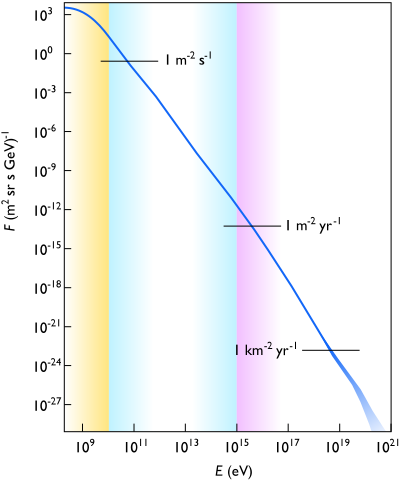
This diagram show the expected flux of cosmic rays as a function of their energy, assuming a power-law distribution. This is in fact what is observed. For example, cosmic rays with an energy of more than 1019 eV are observed at a rate of only 1 per km2 (of Earth surface) per year. So you need to observe over an area of many km2 simply to tally a reasonable number of the most energetic cosmic rays in a few years.

Because of the GZK effect, the flux of cosmic rays takes a sharp drop below the curve in the diagram right around 4×10¹⁹ eV. We still observe a very few cosmic rays with energies above that point, because if the cosmic ray originates from a source sufficiently close to Earth, there is still some nonzero probability it will not collide with a CMB photon. However, there is essentially no chance we will see a cosmic ray of more than 4×10¹⁹ eV if its souce is more than about 250 million light-years (Mly) from Earth.

As it turns out, this limit is actually a stroke of good fortune, because it means that in order to identify sources of UHECRs we need only consider objects within an Earth-centered sphere of radius 250 Mly. We can simply disregard objects that are farther away.

Another simplifying condition is that we don't need to bother with cosmic rays having an energy less than about 3×10¹⁹ eV, because the trajectories of such lower-energy cosmic rays are likely to have been deflected by our galaxy's magnetic field. We couldn't hope to identify the direction from which they came anyway. This is a useful simplification, since there is a larger variety of possible sources for the lower energy cosmic rays, and we would simply have too many possibilities to have a hope of correlating the observed directions with locations of particular source types. Furthermore, atomic nuclei larger than one proton will have more than one unit of charge, so they will also be deflected by the galaxy's magnetic field. And so we would not expect cosmic rays that don't consist of individual protons to have a correlation with the location of specific source objects.

Given all that, it's easy to understand and appreciate the result that was just announced early in November. The result comes from a large team working at the Pierre Auger Observatory in Argentina. The result, in a nutshell, is that out of 15 cosmic ray events with energy more than 6×10¹⁹ eV counted since 2004, 12 came from a direction that was within 3.1° of a known active galactic nucleus (AGN) within 250 Mly of Earth. It is calculated that the probability of this correlation occurring by chance is only about 1 in 1000 if the flux were isotropic.

What about the other 3 (of 15) events? They might have been cosmic rays that consisted of atomic nuclei heavier than a proton, and hence were deflected by galactic magnetic fields. However, these anomalous events were observed near the galactic plane, so their source could have been an AGN we cannot see because of dust in the galactic plane.

It should be mentioned that Auger is nothing like a typical optical observatory. Instead, it consists of a large number of instruments spread over an area of 3000 km2, which is about the size of Rhode Island. Yet since observations began in 2004, only about 80 events with energy more than 4×10¹⁹ eV were tallied, and there were only 27 with energy more than 5.7×10¹⁹ eV (a rate of about 1 per 4 km2 per century), so you can see how rapidly the numbers drop off in this range. Small wonder that cosmic ray astronomers now want to have an even larger observatory built, as well as to continue observations over enough years to reduce the possibility that correlations are due to chance.

Even so, the present results are generally considered to be pretty important – enough, anyway, to have become the cover story of the November 9 issue of Science. And this is even though the result is "only" a statistical correlation between directions of events and known AGNs. It's much too soon to say something like N events have been observed very close to a specific AGN. Also still left open is the construction of a model for exactly how UHECRs are produced in an AGN, let alone the validation of the model in a particular case (as has been done with lower energy cosmic rays and supernova remnants).

It's also only fair to note that objections to the Auger conclusions have been raised – see here, and in some of the references below.

However, we now have a lot better information about UHECRs than we had before.

More information:


Blog articles:


Tags: , , ,

Labels: , , ,

Sunday, November 04, 2007

Readings: Cosmology and astrophysics, 4 November 2007


The text following each item is quoted material, except for editorial comments, which are in color.


FSU physicist shining a light on mysterious 'dark matter'
"Recent scientific breakthroughs have shown that most of the matter in the universe—about four-fifths—is not made up of atoms, but of something else, called 'dark matter,'" said Howard Baer, FSU's J.D. Kimel Professor of Physics. "The evidence for dark matter is now overwhelming, and the required amount of dark matter is becoming precisely known." ...

A theoretical physicist, Baer employs mathematical models and calculations, as opposed to experimental methods, in an attempt to understand the basic properties of dark matter. To that end, he travels frequently to CERN, the world's largest particle physics laboratory, located on the border between France and Switzerland. At CERN, teams of physicists from all over the world are preparing for the start-up of what will be the world's most powerful particle accelerator, the Large Hadron Collider (LHC), in 2008. With the LHC, they will conduct experiments that seek to solve some of the fundamental mysteries of science, including the identity of dark matter. In addition to searches at the LHC, the hunt for dark matter is progressing at experiments deep underground in Minnesota, under thick Antarctic ice, and even in outer space.

Another piece in the dark matter puzzle
“We took one specific theory about dark matter,” Riemer-Sørensen explains. “We look at a specific type of decaying particles, and if they represent dark matter, they will decay and transform into photons in x-rays.” The particles in question are axions, hypothetical elementary particles used in theories describing “extra” dimensions. The idea, she says, is to look for an area of the universe that has a great deal of dark matter, and then look for weak x-ray emissions. ...

So, did Riemer-Sørensen and her colleagues find the weak dark matter x-ray emissions? “We didn’t find any clear signs of x-ray emissions from axions in these regions,” she says. “And that tells us something about dark matter.” If dark matter particles do follow the reactions of decay set forth in the theory of axions as dark matter, then dark matter has an extraordinarily long lifetime. “If dark matter does decay,” Riemer-Sørensen insists, “then the lifetime of the axions is at least three million billion years, which is twenty thousand times longer than the lifetime of the universe.”

Can this experiment identify dark matter?
“Many experiments and observations all point to the existence of some form of matter that is different from the ordinary matter that makes up starts, planets and even people,” Bertone explains. Because dark matter is so prevalent in the universe, many scientists are interested in better understanding its role in fundamental physics, as well as the formation of the universe. “There are efforts to clarify the nature of dark matter.”

Bertone explains that there are three main approaches to detecting dark matter particles, which are likely to be weakly interacting massive particles (WIMPs). The first, he says, is an earthbound method using particle accelerators, like the Large Hadron Collider due to go online at CERN next year. “Scientists hope to find particles in accelerators that could be like the dark matter found in the rest of the universe.”

The next method of detection is one of indirect observation. Looking out into space, Bertone says, scientists “look for some signal due to interaction of particles amongst themselves.”

The strategy set forth in the article belongs to the third approach, which is to build a large detector and wait for a dark matter particle to interact with ordinary matter. “To show the power of this technique, we focused on an experiment called COUPP [Chicagoland Observatory for Underground Particle Physics]” Bertone says. “It is a bubble chamber, much like what has been used before in other fields.”

In the dark: science still mystified by stuff of universe
Most of the universe -- 96 percent, to be exact -- is made of dark matter and energy whose composition we simply do not fathom, a Nobel laureate told physicists gathered this week to explore the intersection of the infinitely small and the infinitely large. ...

Most physicist attending the conference here on astroparticle physics think the basic ingredient is probably some as-yet undiscovered elementary particle, a relic of the "Big Bang" that created the Universe around 13 billion years ago.

The favored candidate is the neutralino, a "supersymmetric" particle whose existence has yet to be proven. But the hunt in underway, using both direct and indirect methods, including experiments to be conducted at the Large Hadron Collider (LHC) in Switzerland.

Over the next decade, explained Katsanevas, scientists will be tackling three big questions besides dark matter: the origin of cosmic rays, the existence of gravitational waves, and the mass of neutrinos, which have provided the first solid evidence of phenomena beyond what is called the Standard Model of particle physics.

Astronomers Aim to Shine Light on Universe's 'Dark Energy'
In nearly a decade since it was discovered, a mysterious cosmic feature dubbed "dark energy" has lain like a downed redwood across the path of scientists trying to reach the holy grail of physics – a fundamental theory of matter and its basic forces. ...

"After about 10 years it's clear [dark energy] is not going away.... We have to really figure out what this is," Riess says. The past decade also has shown that "dark energy lives at the crossroads of two of our best theories of physics: quantum mechanics and general relativity."

A successful marriage of quantum theory and gravity is the last major hurdle in demonstrating that the basic four forces of nature – gravity, electromagnetism, and weak and strong forces that operate at the subatomic level – are manifestations of a single force that dominated the universe in the first few fractions of a second after the big bang. With dark energy, "nature is giving us a hint of how it does quantum gravity," Riess says.

Hubble Telescope: Solved and Unsolved Mysteries
Beyond snapping extraordinary pictures of faraway nebulas, the revolutionary Hubble Space Telescope has completely transformed our view of the universe since it was launched in 1990. By capturing the clearest, deepest images of the cosmos ever, Hubble has shed light on some long-standing mysteries perplexing scientists-while uncovering far deeper ones that have yet to be solved. ...

Dark energy has prompted new theories regarding the origin of the universe, such as one where clashing membranes of reality trigger endless cycles of cosmic death and rebirth, as well as the fate of the universe, raising the possibility that dark energy ends the universe in a Big Rip. Future progress on understanding dark energy's nature will likely require a dedicated dark energy space mission, "for sometime in the middle of the next decade, perhaps," Leckrone said.

The other mysteries mentioned in the article involve dark matter, gamma-ray bursts, direct imaging of extrasolar planets, and protoplanetary disks. These are all issues which can be studied by more or less conventional optical or infrared telescopes – much like Hubble, only more powerful. There is also a need for a more powerful ultraviolet-sensitive telescope, which is not currently even part of NASA's agenda. Although the descriptions of the "mysteries" in the article are sketchy, there are links to additional information.

Is the universe a doughnut?
Later work by Neil Cornish of Case Western University, David Spergel of Princeton University, and Glenn Starkman of the University of Maryland extended this technique to consider a wider range of possible topologies. Such a method has been applied to the WMAP results, examining the possibility that it could have a complex topology— not a toroid perhaps, but rather a dodecahedron (a bit like a soccer ball, but with all sides equivalent in size and shape). Although preliminary data (analysed in 2003) seemed to rule out this model, more recent looks at the WMAP findings have revived the idea that if you venture far enough out into space you'll return to your starting point. Hence Homer's doughnut theory may have at least a sprinkling of truth: the universe could indeed have loops.

This is a pretty good article for an overview of the shape of the universe, in spite of its facetious premise (that a cartoon world can be effectively used to explain highly technical cosmology). The genre, of popular TV shows used as points of embarcation into explanations of scientific topics, is growing. First there was The Physics of Star Trek, which is not too surprising a connection. But The Physics of the Buffyverse? And now, in effect, physics according to Homer Simpson? Having read only the first of these, I don't know that these aren't all quite good books. But what this trend says about our culture... I don't really want to go there.

However, if Robert Gilmore can write physics books based on such metaphorical worlds as those of Alice in Wonderland, The Wizard of Oz, A Christmas Carol, or Grimms' Fairy Tales, ... well, why not? Perhaps we need someone to write books of physics based on The Odyssey or The Divine Comedy? And while we're at it, let's not leave out the physics of the Niebelungenlied and the Mahabharata. I can hardly wait.


Why the Universe is All History
Some galaxies are so remote that their light hasn't had sufficient time to reach us yet, despite about 13.7 billion years of travel. There could also be more distant objects that will forever remain unknown to us.

"Because the universe is expanding and the expansion appears to be accelerating, there may be distant galaxies which if we can't see them now because their light has not had time to reach us, we will never see," Stecker said.

So we can never see the universe as it is, only as it was at various stages of its development.

New-School 'Aether' May Shed Light on Neutron Stars
Among scientists, it is widely believed that there is no such thing as an aether – a medium pervading all space that allows light waves to propagate, similar to how sound needs air or water – but a part of its spirit may live on. A group of University of Maryland (UM) physicists have proposed a modern spin on the aether of old and have used it to make new predictions about the behavior of neutron stars. ...

The UM researchers – Christopher Eling, Ted Jacobson, and Coleman Miller – describe their aether as a preferred state of rest at each point of spacetime. This preferred state would not be the result of something known, such as a gravitational field or cosmic background radiation, but may, they say, arise from the structure of empty space in quantum gravity theory. ...

The UM team use the new aether to make concrete predictions about neutron stars that differ from those generated by general relativity, Einstein’s theory of gravity. The group's calculations show that the maximum mass of neutron stars would be smaller than in general relativity and the increase in wavelength, or “redshift,” experienced by photons emitted from the stars' surfaces must be 10 percent larger.

Predicting Planets
Discovering new planets that orbit distant stars has become commonplace. But now a team of astronomers has managed to predict the orbit of an extrasolar planet — before anyone knew for certain that it existed. The last time that happened was more than 150 years ago. ...

The more-recently discovered planet is known by a rather-less-elegant name: HD 74156d. It is a gas giant, slightly more massive than Saturn, orbiting a sun-like star about 65 parsecs (212 light-years) away. Its orbit was predicted in 2004 by Rory Barnes and Sean Raymond, theoretical astronomers then at the University of Washington in Seattle. Three years later, Jacob Bean, an astronomer now at the Georg-August-Universitaet in Goettingen, Germany, announced that he had found the planet, pretty much where Barnes and Raymond said it would be.

Lonely Planets of the Cosmos
A brief letter in Nature was John Debes's inspiration. The 1999 piece, by David J. Stevenson (Caltech), proposed that planets with liquid water oceans — and even life — could exist in the cold, dark depths of interstellar space far from any star. Based on the knowledge that some fraction of planets must get gravitationally ejected from their systems during the systems' formation, the paper theorized that some of these ejected planets could, with enough internal heat, keep their atmospheres and stay warm enough to support liquid water below a thick frozen crust.

What might happen if such an outcast had a big moon? To find out, Debes (at the Carnegie Institution of Washington) ran 2,700 computer simulations based on an Earth-mass planet and a lunar-mass companion.

The Enduring Mysteries of the Sun
The sun lies at the heart of our solar system, but it still holds back many secrets from science. Unlocking these mysteries could shed light on puzzling activity seen in other stars and even safeguard lives.

It's surprising how much we don't understand about stars – from either theory or observation – considering that we live so close to one.


Tags: , , ,

Labels: , , , , , ,